Introduction
Most manufacturing facilities run automation on disconnected tools—separate software for PLCs, HMIs, and drives—that create data silos, duplicate engineering work, and drag out commissioning timelines. According to NIST estimates, information losses during system handover alone cost 1.8% of capital expenditures, with losses in the operate-maintain phases adding another 2.4%.
Totally Integrated Automation (TIA) is Siemens' unified architecture that connects every layer of production—from field devices to management systems—through one consistent engineering environment: the TIA Portal.
By standardizing communication, data handling, and tooling across all automation levels, TIA cuts fragmented integration challenges and delivers measurable reductions in engineering time, errors, and costs. This guide breaks down how TIA works, what it includes, and how to evaluate whether it fits your facility.
TLDR
- TIA connects all production levels — hardware, controls, and communication — through a single shared database
- TIA Portal consolidates PLC, HMI, drive, and motion control programming in one interface
- Reduces engineering costs by ~10% and enables 98% virtual commissioning readiness
- Used across automotive, aerospace, food and beverage, pharmaceutical, and industrial sectors
- Available as licensed commercial software with a free trial; the TIA Selection Tool helps identify compatible components
What Is Totally Integrated Automation (TIA)?
Totally Integrated Automation is Siemens' automation architecture that standardizes communication, data handling, and engineering tools across all levels of a production facility. It spans from field-level sensors and actuators up through controllers, operator interfaces, and enterprise management systems.
Rather than treating each automation component as a separate island, TIA creates a unified ecosystem where every device shares a common data pool and a common engineering environment.
The Automation Pyramid: Four Levels of Integration
TIA addresses the complete ANSI/ISA-95 automation hierarchy:
- Level 0 (Physical Process): Sensors, actuators, motors, and field devices
- Level 1 (Basic Control): PLCs, I/O modules, and intelligent field devices
- Level 2 (Supervisory Control): HMIs, SCADA workstations, and operator interfaces
- Level 3 (Operations Management): MES systems for workflow and recipe management
- Level 4 (Business Planning): ERP and business logistics systems
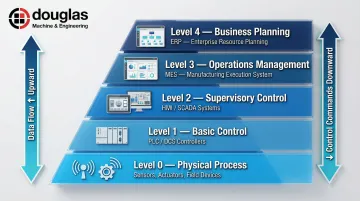
Direct data flow between these levels matters because manufacturing decisions at one level directly impact performance at others. When a recipe changes in MES (Level 3), those parameters must reach controllers (Level 1) and field devices (Level 0) without manual re-entry or translation errors.
TIA vs. Traditional Automation: Why Unification Matters
Traditional automation setups require separate, disconnected engineering tools for each component:
- One software package for PLC programming
- Another for HMI design
- A third for drive commissioning
- Yet another for motion control
This fragmentation forces engineers to define the same data—motor speeds, temperature setpoints, alarm thresholds—multiple times across different platforms. Each handoff introduces opportunities for errors, version mismatches, and costly commissioning delays.
TIA eliminates this redundancy by providing a single engineering environment where a symbol defined once is automatically available across all editors and devices. When you configure a motor speed parameter in the PLC, that same tag appears instantly in the HMI visualization and drive configuration: no duplicate entry, no synchronization errors.
Standardization: The Foundation of TIA
That single-environment approach works because TIA standardizes the communication protocols and interfaces underneath it. Siemens hardware and software components — controllers, drives, HMIs, energy management — all operate on the same foundation. That standardization covers:
- Network protocols: PROFINET for real-time field communication, OPC UA for IT/OT integration
- Data structures: Consistent tag naming and data types across all devices
- Engineering interfaces: Unified look-and-feel across PLC, HMI, and drive configuration
- Diagnostic tools: Common troubleshooting and monitoring capabilities
Origin and Evolution
TIA was developed by Siemens' Digital Factory division as part of the broader Digital Enterprise framework. Originally focused on manufacturing automation, TIA has evolved into a comprehensive platform supporting Industry 4.0 goals, including digital twin simulation, cloud connectivity, and condition-based optimization. The sections below cover how each of these capabilities works in practice — and how manufacturers are applying them on the shop floor.
TIA Portal: The Engineering Heart of TIA
TIA Portal (Totally Integrated Automation Portal) is the single engineering environment where engineers configure, program, commission, and diagnose all automation components within a TIA architecture. From PLCs to HMIs to drives to energy management, it provides one consistent workspace — no tool-switching, no redundant data entry.
The Shared Database Advantage
All components in TIA Portal share a single, consistent data pool. When you define a symbol once—say, a conveyor speed variable—it's automatically synchronized across:
- PLC logic programs
- HMI visualization screens
- Drive parameter sets
- Alarm and diagnostic messages
- Energy monitoring dashboards
This shared database eliminates the duplicate data entry that plagues traditional automation projects and reduces configuration errors by ensuring every component references the same, up-to-date information.
Integrated Multi-User Engineering
TIA Portal supports parallel development through Multiuser Engineering, enabling multiple engineers to work simultaneously on different project sections through a shared Project Server. Key benefits include:
- Develop PLC logic, HMI screens, and drive configurations in parallel — cutting overall timelines
- Track changes automatically to prevent conflicts and overwrites
- Reduce total project duration by 20–30% through overlapping workflows
TIA Portal vs. SCADA: Clarifying the Relationship
TIA Portal is an integrated engineering framework, not a SCADA system itself. SCADA functionality is provided by SIMATIC WinCC within the TIA Portal environment. The distinction is straightforward:
- TIA Portal = The engineering shell containing all configuration tools
- WinCC = The SCADA layer for visualization and supervisory control
WinCC runs inside TIA Portal, meaning you configure both your PLC logic and your SCADA screens in the same interface, sharing the same tag database.
Licensing Structure
TIA Portal is commercial, licensed software—not free. Siemens offers multiple tiers:
- STEP 7 Basic: For SIMATIC S7-1200 controllers
- STEP 7 Professional: For all SIMATIC controllers including S7-1500
- Advanced packages: Include WinCC, motion control, and energy management
Licenses are managed through the Siemens Automation License Manager (ALM) and are available as Floating, Single, or Rental licenses. Siemens provides a free TIA Selection Tool for hardware configuration and 21-day trial licenses for evaluation purposes.
Key Software Components Inside TIA Portal
SIMATIC STEP 7: PLC Programming
STEP 7 is one of the most widely deployed PLC programming environments, integrated into TIA Portal to support all SIMATIC controllers. It complies with the IEC 61131-3 standard and supports five programming languages:
- LAD (Ladder Diagram): Relay-logic style for electrical engineers
- FBD (Function Block Diagram): Graphical blocks for process control
- STL (Statement List): Text-based assembly-like language
- SCL (Structured Control Language): High-level text language similar to Pascal
- S7-Graph (Sequential Function Chart): Step-based logic for sequential processes
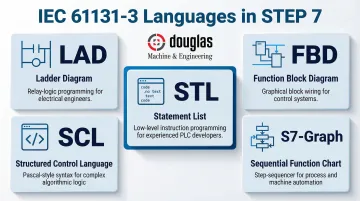
This multi-language support allows engineers to choose the best tool for each control task—ladder logic for discrete I/O, SCL for complex calculations, and Graph for batch processes.
SIMATIC WinCC: Visualization and SCADA
WinCC provides visualization from machine-level HMIs up to full plant-wide SCADA functionality. The WinCC Unified System extends this to cloud-connected, scalable visualization with:
- Web-based access: HTML5 clients for remote monitoring
- Open connectivity: OPC UA (Data Access, Alarms & Conditions) and MQTT for cloud/MindSphere integration
- Regulatory compliance: Audit Trail with automatic checksums for ERES (Electronic Records and Electronic Signatures) compliance in pharmaceutical applications
WinCC's integration with TIA Portal means alarm messages, trend data, and operator screens all reference the same PLC tags—no manual mapping required.
SINAMICS Startdrive and Motion Control
SINAMICS drives (frequency converters) are parameterized directly within TIA Portal through Startdrive, eliminating the need for separate drive commissioning tools. Startdrive provides:
- Drive parameter configuration
- Integrated safety acceptance tests
- Drive Control Chart (DCC) logic for drive-level automation
Beyond drive parameterization, TIA Portal handles full motion control natively through the SIMATIC S7-1500 T-CPU. This CPU manages single and multi-axis systems—including gearing, camming, and kinematics—directly within the PLC, replacing the legacy SIMOTION platform. Siemens announced SIMOTION's phase-out via PM400, with full discontinuation (PM410) scheduled for October 2026.
Key Benefits of TIA for Industrial Operations
Reduced Engineering Time and Cost
The unified interface, shared database, and reusable function libraries in TIA Portal eliminate redundant work and reduce the risk of errors during commissioning. At the Audi A8 production facility in Neckarsulm, the implementation of TIA Portal and its common data platform enabled the company to save approximately 10% of engineering expenditure.
Key factors driving this reduction:
- Define tags once and use them across the entire project
- Draw on pre-built function blocks for common tasks
- Troubleshoot from a single integrated diagnostics interface
- Train staff on one tool instead of five separate platforms
Faster Time-to-Market Through Virtual Commissioning
TIA Portal supports digital twins and simulation, allowing engineers to test and validate automation logic before physical installation. KUKA Systems do Brasil utilized Tecnomatix Process Simulate Virtual Commissioning to get robotics workcells 98% ready before ever going to the shop floor, reducing start-up robotics and control-program tuning work by 20-30%.
Virtual commissioning catches planning errors early—when they're cheap to fix—rather than during on-site commissioning when downtime costs thousands per hour. Engineers can:
- Simulate complete production lines in software
- Test edge cases and failure scenarios safely
- Optimize cycle times before hardware arrives
- Train operators on virtual systems before go-live
Improved Energy Efficiency and Transparency
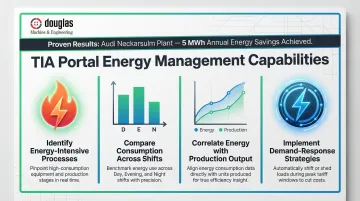
TIA Portal's integrated energy management tools (SIMATIC Energy Suite) give operators real-time visibility into energy consumption across all connected devices. The Audi Neckarsulm factory utilized TIA to save approximately 5 MWh of energy per year.
The Energy Suite collects and visualizes energy data directly in the controller, letting operators cut waste where consumption actually spikes. From the same interface, they can:
- Identify energy-intensive processes
- Compare energy consumption across shifts
- Correlate energy use with production output
- Implement demand-response strategies
Scalability and Future-Readiness
TIA's open architecture and cloud connectivity (TIA Portal Cloud Connector) allow facilities to scale their automation from single machines to entire plant networks, and to integrate with MES, ERP, and cloud platforms. That means a facility can start with a single cell and expand to full plant-wide integration without replacing the underlying platform.
Modern TIA deployments support:
- OPC UA for standard IT/OT integration across mixed-vendor environments
- MQTT for connecting to cloud and IoT platforms
- Web-based HMIs accessible from any browser or device
- MES integration for workflow and recipe management
TIA Applications Across Industries
Automotive Manufacturing
TIA has been implemented extensively in automotive production lines to enable flexible, multi-model manufacturing and reduce downtime through centralized data handling and virtual commissioning. The ŠKODA digital factory project utilized TIA Portal to create a fully virtualized production environment, allowing engineers to test and optimize assembly sequences before physical deployment.
Key automotive applications include:
- Body-in-white welding lines
- Paint shop process control
- Final assembly automation
- Quality inspection and traceability
Aerospace, Defense, and Precision Industrial Manufacturing
Aerospace and defense programs demand strict traceability, audit trails, and repeatable results — areas where TIA's consistent data management delivers measurable value. Fori Automation, for example, uses SIMATIC S7-1500 PLCs, TIA Portal code libraries, and SIMATIC Ident RFID to safely position massive aircraft tooling and verify component parts on the fly.
Precision contract manufacturers like Douglas Machine & Engineering (DM&E) — ISO 9001:2015 and AS9100D certified — produce the tight-tolerance machined components and custom assemblies that go directly into these TIA-enabled systems, where dimensional accuracy at the component level is as critical as the automation architecture itself.
Common aerospace and defense TIA applications include:
- Aircraft tooling positioning and verification
- Component traceability via RFID integration
- Automated quality inspection and audit logging
- Multi-axis CNC machining cell coordination
Food, Pharmaceutical, and Packaging Industries
STAMAG utilizes the SISTAR process control system — built on SIMATIC S7-1500/TIA Portal — for integrated recipe management, batch reports, step logs, and full batch traceability. This makes TIA a practical fit for food and packaging lines where compliance documentation is mandatory, not optional.
For pharmaceutical applications, SIMATIC WinCC Unified supports ERES compliance via an Audit Trail that automatically forms a checksum for each data record to ensure data integrity—critical for FDA 21 CFR Part 11 compliance.
Frequently Asked Questions
What is Totally Integrated Automation (TIA)?
TIA is Siemens' unified automation architecture integrating hardware, software, and communication across all levels of production—from field devices to management systems—through a single engineering environment (TIA Portal). It eliminates data silos and reduces engineering costs by providing a shared database for all automation components.
Is TIA Portal a SCADA system?
TIA Portal is an integrated engineering framework, not a SCADA system itself. However, it contains SIMATIC WinCC, which provides full SCADA functionality ranging from machine-level HMI visualization to plant-wide supervisory control, all configured within the TIA Portal environment.
Is Totally Integrated Automation (TIA) software free?
No. TIA Portal is a commercial, licensed software product with multiple tiers (STEP 7 Basic, Professional, and advanced packages). A free TIA Selection Tool is available for hardware configuration, and Siemens provides 21-day trial licenses for evaluation purposes.
What is the difference between TIA and TIA Portal?
TIA (Totally Integrated Automation) is the overarching architecture and philosophy of unified automation across all production levels. TIA Portal is the specific software engineering environment through which TIA is implemented and managed.
What programming languages does TIA Portal support?
TIA Portal's SIMATIC STEP 7 supports the IEC 61131-3 standard programming languages: Ladder Diagram (LAD), Function Block Diagram (FBD), Statement List (STL), Structured Control Language (SCL), and Sequential Function Chart (S7-Graph).
What industries use Totally Integrated Automation?
Key industries include automotive, aerospace and defense, food and beverage, pharmaceutical, packaging, energy, and general industrial manufacturing. TIA is especially well-suited to operations with strict compliance, traceability, or energy efficiency requirements.