Introduction
Manufacturers today face relentless pressure: product complexity is rising, tolerances are tightening, and delivery windows are shrinking. According to Deloitte's 2026 Manufacturing Industry Outlook, 80% of manufacturing executives plan to invest 20% or more of their improvement budgets into smart manufacturing initiatives — a decisive shift toward automation and integration.
Robotics and computer-integrated manufacturing (CIM) address these demands directly, connecting design, production, quality control, and delivery into a single, responsive system. This article covers what CIM and robotics are, how they work together, their key components, real-world benefits, implementation challenges, and where intelligent manufacturing is heading.
Key Takeaways:
- CIM connects design, planning, production, and business systems through digital networks
- Industrial robots deliver precise, consistent physical execution with real-time data feedback
- Manufacturers see fewer defects, shorter lead times, and earlier maintenance alerts
- Aerospace, automotive, pharmaceutical, and food packaging industries benefit most
- Main implementation hurdles: system integration complexity, upfront capital, and workforce training
What Is Robotics and Computer-Integrated Manufacturing?
Computer-Integrated Manufacturing (CIM) is the use of computers to control and coordinate an entire production process—not just isolated machines, but engineering, business, and factory floor functions unified through digital communication networks. The National Institute of Standards and Technology (NIST) defines CIM as "the integration of all the processes necessary to manufacture a product through the use of computer technology", extending beyond manufacturing data to include business procedures, corporate goals, and management structures.
CIM is both a manufacturing method and a philosophy. It connects departments through a shared data backbone — eliminating the silos that slow decision-making and introduce errors. Those departments typically include:
- Design and engineering
- Planning and purchasing
- Inventory control and quality assurance
- Distribution and business management
The concept originated with Dr. Joseph Harrington, who coined the term in his foundational 1973/1974 book Computer Integrated Manufacturing. Over the decades, CIM evolved from basic CAD/CAM and numerical control (NC/CNC) into an enterprise-level integration strategy that spans every phase of production.
Robotics in the Manufacturing Context
Industrial robotics are automated mechanical systems equipped with sensors, actuators, and programmable controls capable of performing physical tasks—from welding and assembly to material handling and quality inspection—with consistent precision. The International Federation of Robotics (IFR), utilizing ISO 8373:2021, defines an industrial robot as an "automatically controlled, reprogrammable multipurpose manipulator for use in automation applications in an industrial environment".
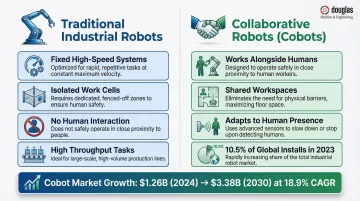
The key difference between traditional industrial robots and collaborative robots (cobots) comes down to how they interact with humans. Traditional robots are fixed, high-speed systems confined to isolated work cells. Cobots work alongside humans — adapting to shared workspaces and complementing human skills rather than replacing them outright. In 2023, cobots accounted for 10.5% of all industrial robots installed worldwide, with the global collaborative robot market projected to grow from $1.26 billion in 2024 to $3.38 billion by 2030, registering a CAGR of 18.9%.
Key Components of a CIM System
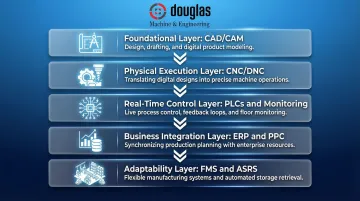
A CIM system integrates multiple technology layers, each serving a distinct role in the design-to-delivery workflow.
CAD and CAM: The Foundational Layer
Computer-Aided Design (CAD) digitally models parts and products, enabling engineers to iterate designs rapidly without physical prototypes. Computer-Aided Manufacturing (CAM) then translates those models into production instructions—toolpaths, machining sequences, and process parameters—automating the full design-to-fabrication pipeline.
DM&E uses this approach directly: CAD tools including PTC Creo, CATIA v5, and AutoDesk AutoCAD, paired with FeatureCAM CNC programming, convert customer designs into production-ready specifications without relying on external engineering resources.
CNC and DNC: The Physical Execution Layer
Computer Numerical Control (CNC) machine tools receive digital instructions and carry out precise machining operations. CNC systems achieve exceptional repeatability, holding tolerances of ±0.0127 mm (±0.0005 inches) through closed-loop servo controls and digital execution. In contrast, manual machining relies on physical adjustment and hand control, introducing dimensional variations that can reach 0.127 mm across successive parts.
Direct/Distributed Numerical Control (DNC) is the networking architecture used to link CNC machine tools. When a CNC controller lacks the memory to store complex machining programs, DNC systems store the program on a separate computer and send it directly to the machine one block at a time—a process known as "drip-feeding". DNC allows a central computer to distribute programs to multiple machines, ensuring centralized version control and seamless CAM integration.
PLCs and Monitoring Equipment: The Real-Time Control Layer
Programmable Logic Controllers (PLCs) and monitoring equipment act as the nervous system of the factory floor—sequencing operations, triggering alarms, and feeding live sensor data back into the system. This closed-loop feedback ensures processes stay within specification limits in real time.
ERP and Production Planning: The Business Integration Layer
Enterprise Resource Planning (ERP) and production planning and control (PPC) systems pull business operations into the same data environment as the factory floor. Key functions managed through this layer include:
- Order entry and cost accounting
- Inventory tracking and material availability
- Production scheduling and capacity planning
- Customer delivery commitments
This integration eliminates the gap between business decisions and manufacturing execution, giving teams real-time visibility into what's being built, what's in stock, and when orders ship.
FMS and ASRS: The Adaptability Layer
Flexible Manufacturing Systems (FMS) bridge the gap between highly automated lines and standalone CNC machines, allowing for the efficient mid-volume production of a diverse part mix with low setup times. Automated Storage and Retrieval Systems (ASRS) complement FMS by automatically storing and delivering tool assemblies and materials to machining cells. Implementations of flexible methodologies (like SMED) alongside automation have yielded changeover time reductions ranging from 50% to 70%, which is critical for job shops and mixed-production environments.
How Robotics and CIM Work Together
The core synergy between robotics and CIM lies in real-time data exchange. Robotic systems on the factory floor generate continuous sensor data—position, force, speed, error rates—that feeds directly into the CIM network, enabling data-driven adjustments to production plans, quality thresholds, and scheduling. That data flow is what separates modern intelligent manufacturing from the older, reactive model where problems were discovered after the fact.
A Concrete Example of Integration
Consider robotic arms on an assembly or machining line. These robots receive updated toolpath instructions from CAM software, adjust to in-process quality measurements from sensors, and log all output to the ERP system—creating a continuous feedback loop from design through delivery. If a sensor detects dimensional drift, the system can automatically adjust machining parameters or trigger an alarm, preventing defective parts from progressing down the line.
Machine Learning and AI Amplify the Synergy
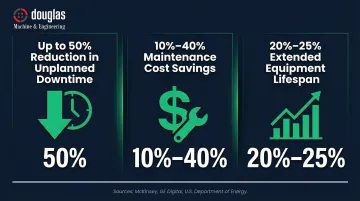
AI-driven predictive maintenance is changing how manufacturers manage equipment reliability. By analyzing real-time sensor data (vibration, temperature, pressure), AI algorithms identify failure patterns before they cause catastrophic breakdowns. According to McKinsey and GE Digital, predictive maintenance reduces unplanned downtime by up to 50% and cuts maintenance costs by 10% to 40%. The U.S. Department of Energy reports that predictive maintenance can extend equipment lifespan by 20% to 25%.
Robots can also learn from historical production data to optimize motion paths and adapt to new part configurations with minimal reprogramming. That machine learning capability is most powerful when it operates within a fully integrated CIM environment.
When design, production, quality control, inventory, and shipping all share the same real-time data environment, the results are measurable:
- Lead times shrink as scheduling adjusts automatically to real floor conditions
- Error rates fall because quality issues trigger corrections before defects propagate
- On-time delivery improves through visibility across every stage of production
Industry Applications and Real-World Benefits
Robotics and CIM have the deepest impact in industries where precision, traceability, and consistency are non-negotiable.
Industries Leading Adoption
Automotive: Assembly, welding, and painting operations benefit from high-speed, repetitive robotic tasks. In 2023, the automotive industry installed 135,461 industrial robots globally.
Aerospace and Defense: Tight-tolerance machining, complex assemblies, and strict traceability demands make CIM certification alignment (such as AS9100D or ISO 9001:2015) especially critical. DM&E, for example, applies these principles directly — providing AS9100D-certified CNC machining and full project management for aerospace and defense programs, so customers don't have to coordinate multiple vendors.
Food and Pharmaceutical: Hygienic automated packaging and process control ensure compliance with FDA and safety regulations.
Shipbuilding and Industrial Manufacturing: Large-scale fabrication and assembly benefit from robotic welding and material handling.
Key Operational Benefits
Across these sectors, manufacturers adopting CIM and robotics report measurable improvements:
- Reduced production lead times through automated workflows and real-time scheduling
- Lower defect rates via consistent robotic precision and automated quality inspection
- Improved material utilization by optimizing toolpaths and reducing scrap
- Greater capacity without proportional headcount increases, enabling growth without linear labor scaling
- Consistent quality from first article through final delivery, supported by digital traceability
For example, Ford Motor Company implemented an automated, camera-based in-line quality inspection system that improved defect detection by 90% compared to manual human inspection.
Global Robot Adoption Trends
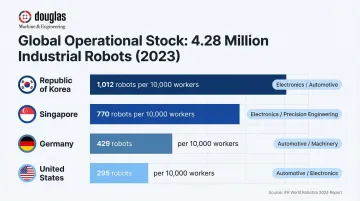
According to the International Federation of Robotics (IFR) World Robotics 2024 report, the global operational stock of industrial robots reached 4.28 million units in 2023. Robot density varies significantly by region:
| Region / Country | Robot Density (per 10,000 employees) | Key Sectors |
|---|---|---|
| Republic of Korea | 1,012 | Electronics, Automotive |
| Singapore | 770 | General Manufacturing |
| Germany | 429 | Automotive, Metal/Machinery |
| United States | 295 | Automotive, Aerospace |
Challenges of Implementation and How to Address Them
Despite the benefits, manufacturers face significant hurdles when adopting CIM and robotics.
Primary Barriers to Adoption
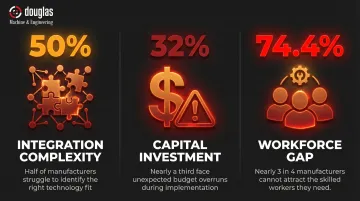
Integration Complexity: Different machines from different vendors use different communication protocols, making seamless data exchange difficult. A recent industry survey found that 50% of manufacturers struggle to identify the right technology, and nearly half report integration challenges regarding installation and system flexibility.
Data Integrity: As automation increases, the quality and security of data signals becomes mission-critical. Corrupted or inaccurate data can cascade through the system, causing production errors and quality failures.
Capital Investment: Upfront costs for CNC systems, robotics, and software integration run high. The same survey revealed that 32% of manufacturers experience budget overruns during automation deployments.
The Workforce Dimension
CIM and robotics shift the labor requirement from manual operation toward programming, system oversight, maintenance, and data analysis. In a 2023 National Association of Manufacturers (NAM) survey, 74.4% of respondents cited the inability to attract and retain workers as their primary business concern. Furthermore, 75% of employers globally struggle to staff open roles with the necessary technical talent. Companies need a plan for upskilling existing employees and recruiting for new technical roles.
A Practical Path Forward
One practical approach is partnering with a manufacturer that already has integrated CIM capabilities in-house — design, CNC machining, fabrication, and quality assurance under one roof. This eliminates multi-vendor integration headaches and keeps data and quality integrity in a single chain of custody.
DM&E operates this way: its concept-to-installation model manages design, machining, and specialized processes under unified project oversight, reducing purchase orders, vendor handoffs, and the quality gaps that come with them.
The Future of Intelligent Manufacturing
Robotics and CIM don't operate in isolation — they're increasingly connected to a broader ecosystem of technologies that are reshaping what factories can do.
Digital Twins and ISO 23247
A digital twin is a "fit for purpose digital representation of an observable manufacturing element with synchronization between the element and its digital representation," as defined by ISO 23247-1:2021. Supported by NIST, digital twins are used for virtual commissioning—allowing engineers to test control code, optimize servo parameters, and simulate workflows before physical machines are installed, eliminating the risk of hardware damage before a single line of production runs.
5G Enabling Faster Machine-to-Machine Communication
Advanced connectivity is accelerating smart factory adoption. The private wireless network market is projected to grow at a 23% CAGR, increasing from $6.27 billion in 2024 to $32.86 billion by 2032. Ericsson reports that 60% of surveyed industrial private 5G networks are already deploying two or more use cases simultaneously — such as autonomous guided vehicles and connected machine vision cameras.
IoT-Connected Sensors and AI-Driven Quality Inspection
IoT-connected sensors feed real-time data across entire production floors, enabling AI-driven quality inspection that outperforms manual checks at speed and scale. These systems improve over time by learning from production data — catching defect patterns that static inspection criteria would miss.
Common applications include:
- Surface defect detection on machined or welded components
- Dimensional variance monitoring against CAD tolerances
- Real-time alerts when process parameters drift outside spec
- Automated rejection or rework flagging without line stoppage
The Smart Factory Concept
Deloitte defines the smart factory as an environment where "agile flexibility allows the smart factory to adapt to schedule and product changes with minimal intervention". For contract manufacturers and industrial shops, this means less reliance on manual scheduling adjustments when a customer changes specs mid-run — and fewer costly delays when a machine goes down. Investing in CIM infrastructure now is what separates facilities that can absorb disruption from those that can't.
Frequently Asked Questions
What is robotics and computer integrated manufacturing?
CIM is the use of computers to integrate and control all phases of manufacturing—from design and planning through production and delivery—while robotics provides the automated physical execution layer. Together, they form production environments where every system communicates, coordinates, and responds in real time.
What are the main components of a CIM system?
Core subsystems include:
- CAD/CAM for design and production programming
- CNC/DNC machine tools for execution
- PLCs for process control
- ERP systems for business integration
- Robotic systems for physical task automation
How do robots improve manufacturing quality and efficiency?
Robots perform repetitive tasks with consistent precision, reduce human error, generate live performance data, and can operate continuously. This directly reduces defect rates and increases throughput.
What industries benefit most from robotics and CIM?
Automotive, aerospace and defense, pharmaceutical, food packaging, and shipbuilding industries benefit most due to their high precision requirements, complex assemblies, and need for production traceability.
What are the biggest challenges in implementing CIM?
Primary challenges include system integration across different equipment vendors, maintaining data integrity in highly automated environments, the upfront capital investment, and the need to upskill the workforce.
How is AI changing the future of robotics in manufacturing?
AI enables robots to learn from production data, predict equipment failures before they occur, adapt to new part configurations autonomously, and optimize motion paths. The result is a shift from fixed automation toward systems that continuously improve on their own.