
Introduction
Known as the "Mother of All Machine Tools," the lathe has been central to precision manufacturing since ancient Egyptian workshops around the 4th century BC. Today, CNC-controlled versions of that same fundamental machine produce the aerospace components, agricultural equipment, and industrial parts that modern industries depend on.
Yet many engineers and procurement teams still struggle to distinguish one lathe type from another, or to assess whether a machining partner has the right equipment for the job. This guide covers everything you need to know: what a lathe machine is, how it works, its key components, the main types, and the industries that rely on it most.
Key Takeaways
- A lathe rotates a workpiece against a stationary cutting tool to remove material and create cylindrical or symmetrical shapes
- Core components include the bed, headstock, spindle, tailstock, chuck, carriage, and cutting tool, all of which directly affect dimensional accuracy
- Types range from manual engine lathes to computer-controlled CNC turning centers capable of multi-axis milling in a single setup
- Applications span aerospace turbine shafts, automotive driveshafts, medical implants, and industrial valve bodies
What Is a Lathe Machine?
A lathe machine is a machine tool that rotates a workpiece about an axis while a stationary cutting tool removes material to create cylindrical or symmetrical shapes. Think of peeling an apple: the apple spins while your knife stays still, shaving away the skin in controlled layers. That same principle drives lathe operations, from machining brake drums to precision aerospace components.
Historical Evolution and the "Mother of All Machine Tools"
The lathe's lineage stretches back to ancient Egypt around the 4th century BC, as depicted in the Tomb of Petosiris. During the Industrial Revolution, Henry Maudslay's screw-cutting engine lathe (circa 1800) transformed metalworking by introducing a slide rest and lead screw geared to the spindle. This breakthrough enabled accurate screw threads, interchangeable parts, and machining accuracy to several thousandths of an inch—later achieving 0.0001-inch precision.
The lathe earned its "mother" designation because it was the first machine tool that led to the invention of other machine tools. Lathes machined the screws, spindles, and gears required to build milling machines, drills, and grinders — making every subsequent machine tool dependent on lathe-produced components to exist.
How Does a Lathe Machine Work?
The Three-Step Working Process
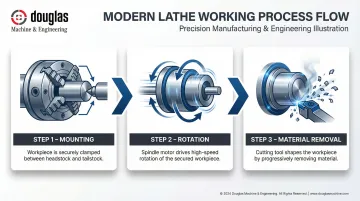
Lathe operation follows three distinct phases:
- Mounting: The workpiece is secured between the headstock and tailstock using a chuck or centers
- Rotation: The spindle rotates the workpiece at a controlled speed about its axis
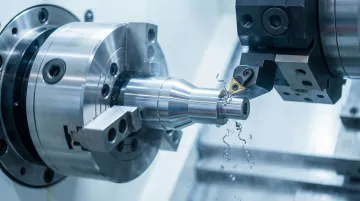
- Material Removal: The cutting tool, held in the tool post on the carriage, is fed into the rotating workpiece to remove material and form the desired shape
Speed, Feed Rate, and Surface Finish
Operators or CNC programs control two critical variables:
- Spindle RPM: Calculated using the formula $N = (12 × V) / (π × D)$, where $V$ is cutting speed in feet per minute and $D$ is workpiece diameter in inches
- Feed Rate: The distance the tool advances per spindle revolution (inches/rev or mm/rev)
These parameters determine surface finish, dimensional accuracy, and material removal rate for different materials and cut types. Theoretical surface roughness ($Ra$) follows the formula $Ra = f^2 / 32r$, where $f$ is feed rate and $r$ is tool nose radius. Best surface finishes result from high speeds with low feeds.
How the tool moves along that axis of rotation is what determines the final geometry. By controlling tool path direction and depth, operators produce cylindrical, conical, threaded, and faced surfaces from a single rotating workpiece.
Key Components of a Lathe Machine
Bed: The Foundation of Precision
The bed is a heavy, rigid horizontal beam that supports all other components. Bed rigidity directly determines machining accuracy because any flex introduces dimensional error. Most beds are made from cast iron (such as gray cast iron, HT300, or Meehanite) rather than welded steel. The morphology of graphite flakes in gray cast iron provides exceptional vibration damping capacity, absorbing compressive and vibrational loads without initiating cracks. This damping prevents chatter, ensuring dimensional accuracy and thermal stability during high-speed machining.
Headstock and Spindle
The headstock houses the main spindle and its bearings, transmits motor power to the workpiece, and contains speed-changing mechanisms — gears, belts, or electronic controls. The spindle itself is the hollow, rotating shaft that holds or drives the workpiece.
Modern CNC lathes take this further with electronically controlled spindles that adjust speed automatically, maintaining constant surface speed as diameter changes during facing operations.
Tailstock
The tailstock is the adjustable support mounted opposite the headstock. It slides along the bed to accommodate different workpiece lengths, supports long workpieces to prevent deflection during turning, and can hold drill bits for axial hole-making. Even 0.001-inch of tailstock misalignment can produce tapered parts instead of true cylinders — so dialing it in before cutting is non-negotiable.
Carriage, Cross-Slide, and Tool Post
The carriage travels along the bed and carries the cross-slide (which moves perpendicular to the bed) and the tool post (which holds the cutting tool). The compound rest provides additional angular movement for tapered cuts and threading. On CNC lathes, servo motors drive these axes with repeatability to 0.0001 inch.
Chuck and Work-Holding Accessories
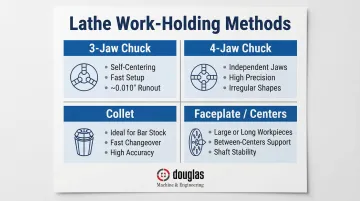
The carriage controls where the tool cuts — the chuck controls what it's cutting. The chuck grips and centers the workpiece on the spindle, and the choice of chuck type directly affects setup time and achievable accuracy:
| Feature | 3-Jaw Chuck | 4-Jaw Chuck |
|---|---|---|
| Mechanism | Scroll gear moves all three jaws simultaneously (self-centering) | Each jaw is adjusted independently via a screw |
| Setup Time | Very fast; quick workpiece changes | Slower; requires manual dialing in with an indicator |
| Accuracy | Moderate; typically around 0.010" runout | High precision; can achieve 0.000" to 0.001" accuracy |
| Best Applications | Standard cylindrical or hexagonal stock | Square, irregular, or eccentric parts; off-center turning |
Other work-holding options include:
- Faceplates — for large, flat, or irregularly shaped workpieces that won't fit a chuck
- Collets — for bar stock, offering high accuracy and fast changeovers in production runs
- Centers — for long shaft work supported between the headstock and tailstock
Types of Lathe Machines
Engine Lathe
The engine lathe is the most common and versatile type—originally powered by steam engines, now electric—used for general-purpose metalworking including turning, threading, boring, and facing. It remains a staple of both tool rooms and production floors for its flexibility and operator control.
Turret Lathe
A turret lathe replaces a single tool post with a rotating turret that holds multiple cutting tools, enabling rapid sequential operations without manual tool changes. This design is ideal for producing identical parts in medium to high volumes, reducing cycle time by eliminating tool-change delays.
CNC Lathe
CNC lathes automate tool movement through computer programming, running complex multi-step operations with minimal human intervention. This translates directly to tighter consistency, better repeatability, and higher throughput in production environments.
Modern CNC turning centers feature:
- Y-axis travel up to 300 mm, enabling off-center drilling and milling in one setup
- B-axis indexing at 0.001° resolution for precise angled features
- Sub-spindles that handle part transfer and backside machining without operator intervention
- Tool magazines with 60 to 120 tool capacity, supporting complete part finishing without changeovers
These capabilities matter most in demanding sectors like aerospace, defense, and heavy industry. DM&E's recently expanded CNC production shop puts them to work on components up to 20,000 lbs, holding tolerances from +/-.005 to +/-.0005 inches.
Tool Room Lathe
Tool room lathes are precision-built engine lathes with tighter tolerances and finer speed control than standard engine lathes. Their primary use is producing precision tools, dies, jigs, and one-off custom parts where accuracy is critical. These machines typically feature hardened and ground bedways, precision spindle bearings, and micrometer-adjustable tool positioning.
Vertical Lathe (VTL)
Vertical lathes feature a vertical spindle axis used for very large-diameter, heavy, or short workpieces that would be difficult to mount horizontally. Common in heavy industry for machining large flanges, rings, and housings, VTLs take advantage of gravity when securing massive parts that would sag or deflect on a horizontal spindle.
Common Lathe Machine Operations
Primary Operations
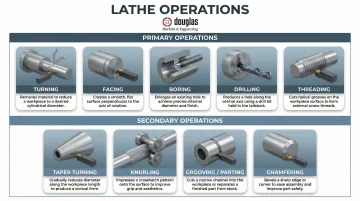
Lathes perform several fundamental operations, each requiring specific cutting tool geometry and setup:
- Turning: Reducing outer diameter to produce cylindrical parts
- Facing: Machining a flat end surface perpendicular to the axis
- Boring: Enlarging an internal hole to precise diameter and finish
- Drilling: Creating axial holes using the tailstock or turret
- Threading: Cutting helical screw threads on external or internal surfaces; requires synchronized spindle speed and feed rate
Secondary Operations
Additional operations expand the lathe's versatility:
- Taper Turning: Producing conical shapes by offsetting the tailstock or using the compound rest
- Knurling: Creating a textured grip surface by pressing diamond or straight patterns into the workpiece
- Grooving/Parting: Cutting grooves or separating a finished part from bar stock
- Chamfering: Beveling an edge to remove sharp corners and ease assembly
The ability to perform multiple operations on a single machine makes the lathe especially valuable for reducing setup time and maintaining dimensional consistency across a part's features.
Modern CNC mill-turn centers push this further — allowing off-center and angled drilling and milling in a single setup, cutting lead times and eliminating tolerance stacking errors that occur when moving parts between separate machines.
Industrial Applications of Lathe Machines
Automotive and Mechanical Manufacturing
Common automotive components produced on a lathe include:
- Driveshafts and crankshafts
- Axles and gear blanks
- Bushings and brake components
The automobile industry dominates the precision turned product manufacturing market, holding a 37.5% share in 2025. The shift toward electric vehicles (EVs) is driving demand for precision shafts capable of supporting 20,000 RPM axial-flux motors and battery system components.
Aerospace and Defense Applications
Turbine shafts, hydraulic fittings, landing gear components, missile housings, and precision fasteners all require the tight tolerances achievable on a lathe. Aerospace-grade lathe work must meet strict quality standards such as AS9100D certification to ensure part reliability.
For defense and government contracts, suppliers must also hold federal procurement qualifications — including SAM registration and a CAGE Code — to be considered for sourced components.
Medical, Energy, and Industrial Applications
Surgical instruments, implant components, valve bodies, pump shafts, and semiconductor equipment parts all rely on lathe machining. The lathe's ability to hold micron-level tolerances is critical in medical and energy applications where part failure is not an option.
The medical and dental segment is projected to advance at a 6.66% CAGR, driven by the need for micro-machined components like orthopedic implants, femoral stems, and pedicle screws. Manufacturers must comply with stringent regulatory frameworks, including ISO 13485 and the FDA's Quality Management System Regulation (QMSR) under 21 CFR Part 820.
Market Growth and Broader Applications
The global CNC machining and turning centers market was valued at $25.99 billion in 2023 and is projected to reach $40.61 billion by 2030, growing at a CAGR of 6.6%. Beyond heavy industry, lathe machining also serves robotics, food-grade packaging, agricultural equipment, and pharmaceutical sectors—making it one of the most broadly applied manufacturing processes across both high-precision and high-volume production environments.
Frequently Asked Questions
What is a lathe machine used for?
A lathe machine is used to shape materials—primarily metal and wood—by rotating a workpiece against a stationary cutting tool. Key uses include turning, boring, threading, drilling, and knurling for producing parts across automotive, aerospace, medical, and industrial industries.
What are the main components of a lathe machine?
Core components include the bed (rigid foundation), headstock (houses spindle and drive), spindle (rotating shaft), tailstock (adjustable support), carriage (moves cutting tool), cross-slide (perpendicular movement), tool post (holds cutting tool), and chuck (grips workpiece). Each works together to maintain precision and enable controlled material removal.
What is the difference between a CNC lathe and a manual lathe?
A CNC lathe is computer-controlled for automated, highly repeatable operations ideal for production runs, while a manual lathe relies on operator skill for each cut. CNC lathes offer greater precision, speed, and consistency for complex or high-volume parts, with modern systems capable of holding tolerances to 0.0001 inch.
What materials can be machined on a lathe?
Lathes can machine steel, aluminum, stainless steel, brass, titanium, cast iron, and various plastics and resins. The material determines the cutting tool type (carbide, ceramic, or CBN), along with the appropriate speed and feed rate.
What industries use lathe machines?
Key industries include aerospace, defense, automotive, medical, oil and gas, robotics, agricultural equipment, and food processing. Precision cylindrical components are critical across all of them. DM&E supports many of these sectors through ISO 9001:2015 and AS9100D-certified CNC turning, handling projects from design through final inspection.