Introduction
Picture an aerospace bracket with internal cooling channels that curve through three dimensions, machined to tolerances tighter than a human hair's width. Or a pharmaceutical component where surface finish directly affects sterility and patient safety. These mission-critical parts are produced daily through CNC manufacturing — a process that replaces manual machine operation with computer-programmed precision.
CNC stands for Computer Numerical Control: automated control of machine tools through pre-programmed software instructions. This article covers how the process works, the main types of CNC machining, the benefits it delivers, and the industries that depend on it — so you can make an informed decision about CNC as a manufacturing approach.
TLDR
- CNC means Computer Numerical Control—machines follow pre-programmed software, not manual operators
- The workflow moves from CAD design → CAM programming → G-code generation → machine execution
- Main types: milling, turning, drilling, EDM, plasma cutting, and water jet cutting
- Delivers tight tolerances (±0.0002"), repeatable accuracy, high speed, and complex geometry capability
- Used across aerospace, defense, agricultural, pharmaceutical, robotics, and industrial applications
What Does CNC Stand For in Manufacturing?
CNC stands for Computer Numerical Control—the automated control of machine tools (mills, lathes, grinders, routers) through pre-programmed computer commands rather than manual levers or hand controls. Instead of an operator physically guiding a cutting tool, the machine reads digital instructions that specify every movement, speed, and position.
CNC removes human variability from the cutting process entirely. Manual machining depends on operator skill, attention, and physical stamina—factors that introduce inconsistency across production runs. CNC machines execute the same program identically every cycle, delivering consistent results at high volume without fatigue or human error as constraints.
How Does CNC Manufacturing Work?
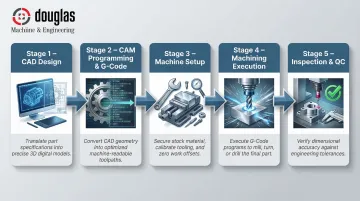
CAD Design
Every CNC part begins as a digital model created in Computer-Aided Design (CAD) software. This 2D or 3D blueprint defines every dimension, contour, hole, and feature of the finished component with mathematical precision. The CAD file serves as the single source of truth—capturing design intent that will guide every subsequent manufacturing step.
CAM Programming and G-Code Generation
The CAD file is imported into Computer-Aided Manufacturing (CAM) software, which translates the design into machine instructions called G-code and M-code:
- G-code controls tool paths, feed rates, spindle speed, depth of cut, and coordinate positioning—the actual cutting movements
- M-code manages external machine functions like coolant on/off, tool changes, and spindle rotation direction
Together, these instructions govern both cutting precision and machine behavior — making CAM programming the step where part quality is largely decided before the machine ever moves.
Machine Setup
An operator prepares the machine by:
- Loading the raw material (workpiece) into the machine
- Selecting and installing the correct cutting tools
- Configuring workholding fixtures (vises, clamps, chucks) to secure the material
- Setting tool offsets and work coordinates
For multi-operation jobs, Automatic Tool Changers (ATCs) enable the machine to swap cutting tools mid-program without operator intervention—critical for complex parts requiring multiple operations.
Machining Execution and Control Systems
The machine reads the G-code and executes the programmed movements. Two control system types govern this execution:
- Open-loop systems send one-way signals to motors without feedback. Simpler and less expensive, they suit basic operations where modest precision is acceptable.
- Closed-loop systems use feedback loops that continuously monitor actual position and velocity, comparing them to commanded values and correcting errors in real time.
Industrial-grade CNC work runs on closed-loop control. Without it, maintaining tight tolerances across long production runs isn't reliably achievable.
Inspection and Quality Control
After machining, finished parts are measured and tested against original design specifications. Advanced CNC setups include in-process sensors and machine vision systems that catch deviations before a run completes, reducing scrap and rework. Final verification typically involves:
- Coordinate measuring machines (CMMs)
- Calibrated gauges and surface measurement tools
- First article inspection (FAI) reports, required for aerospace and defense applications
Types of CNC Machining Processes
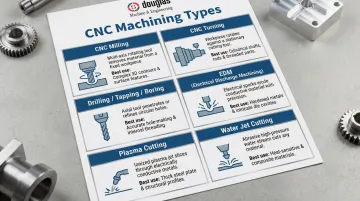
CNC Milling
The workpiece remains stationary while rotating cutting tools move along multiple axes (3-axis through 5-axis configurations) to remove material. Milling creates features, pockets, contours, slots, and holes in prismatic parts.
Multi-axis milling enables complex geometries that would require multiple setups on simpler machines—reducing handling time, improving accuracy, and making undercuts, compound angles, and contoured surfaces achievable in a single setup.
CNC Turning (Lathes)
The workpiece spins while a stationary cutting tool shapes it—ideal for producing cylindrical or round parts:
- Shafts
- Bushings
- Flanges
- Threaded components
CNC lathes typically operate on X and Z axes, delivering high-volume output with minimal variation.
Drilling, Tapping, and Boring
These secondary operations are often performed within the same CNC setup as milling or turning:
- Drilling creates holes to precise depths and diameters
- Tapping cuts internal threads for fasteners
- Boring enlarges existing holes to tight diameter tolerances and improves surface finish
Combining these operations in a single setup reduces handling and maintains tighter positional tolerances between features.
EDM (Electric Discharge Machining)
EDM uses controlled electrical sparks between two electrodes to erode material—useful for hardened metals and intricate internal geometries that cutting tools cannot reach. Two main subtypes exist:
- Wire EDM: A thin wire electrode cuts along a programmed path, tracing complex 2D profiles through thick materials with high dimensional accuracy. It's ideal for complex 2D profiles through thick materials
- Sinker EDM: A shaped electrode is plunged into the workpiece to create cavities, pockets, or complex 3D forms
In aerospace and tooling applications, EDM is often the only viable process for features like narrow slots in hardened tool steel or blind cavities with no draft angle.
Plasma Cutting and Water Jet Cutting
Where EDM removes material spark by spark, plasma and water jet cutting work at the macro scale—suited for sheet and plate work rather than tight-tolerance features. Plasma cutting uses an electrically generated plasma arc to cut conductive metals at high speed—effective for structural steel, aluminum plate, and stainless sheet in thicknesses from gauge to several inches.
Water jet cutting uses high-pressure water (sometimes mixed with abrasive garnet) to cut hard materials without generating heat. This makes water jet preferable when thermal distortion would compromise material properties—common with aerospace alloys, composites, and heat-sensitive materials where metallurgical structure must remain unchanged.
Key Benefits of CNC Manufacturing
Precision and Repeatability
CNC machines can hold extremely tight tolerances—high-end equipment routinely achieves ±0.0002 inches, with some specialized machines reaching even tighter specifications. Once a program is verified, every subsequent part produced matches the original specification.
This repeatability is critical in industries where dimensional accuracy is a safety requirement—aerospace structural components, medical implants, and defense systems where out-of-tolerance parts can cause catastrophic failures.
Speed and Scalability
CNC machines can run continuously (24/7 with minimal human intervention), cutting lead times compared to manual machining. The same digital program supports both prototype runs and full-scale production—switching between quantities requires no new tooling, only adjustments to the program or machine setup.
That flexibility matters when customer demand shifts overnight and retooling delays aren't an option.
Reduced Waste and Lower Operating Costs
Because CNC cuts are pre-programmed and optimized, material removal is precise—reducing scrap compared to manual machining. ISO 9001:2015 certified manufacturers demonstrate continuous improvement in process efficiency, further driving down waste and operating costs through documented quality management systems.
Automated operation reduces labor costs per part, especially for high-volume production where setup time is amortized across thousands of units.
Material Versatility
CNC machines process a wide range of materials without requiring specialized equipment for each class:
- Aluminum alloys (6061, 7075, 2024)
- Stainless steel (303, 304, 316, 17-4 PH)
- Brass and copper
- Titanium (Grade 2, Grade 5)
- Tool steels and hardened alloys
- Engineering plastics (Delrin, PEEK, nylon, polycarbonate)
- Composites (carbon fiber, fiberglass)
A single CNC shop can run aerospace-grade titanium in the morning and pharmaceutical-grade stainless steel housings in the afternoon—same equipment, same precision standards, no material-specific retooling required.
Industries That Rely on CNC Manufacturing
Aerospace and Defense
Aerospace and defense sectors impose the most demanding CNC requirements—structural components, engine parts, and housings must meet extremely tight tolerances and pass rigorous certification standards. Aerospace CNC suppliers typically need AS9100D certification in addition to ISO 9001:2015 to qualify as approved vendors.
AS9100D adds aerospace-specific requirements including counterfeit part prevention, configuration management, and product safety controls beyond general ISO 9001 standards. DM&E holds both ISO 9001:2015 and AS9100D certifications, making the company a qualified partner for aerospace and defense programs that require documented quality systems and traceability.
Industrial, Agricultural, and Robotics
CNC manufacturing produces precision mechanical components that keep industrial machinery, agricultural equipment, and robotic systems functioning reliably:
- Gears and gear housings
- Actuator components
- Mounting brackets and structural supports
- Hydraulic fittings and manifolds
- Custom automation components
Repeatability across large production runs matters in all three sectors. Agricultural equipment manufacturers need hundreds of identical hydraulic fittings; robotics integrators need mounting brackets that hold positional accuracy across every unit in a batch. CNC machining delivers that consistency at scale.
Pharmaceutical and Food Grade Packaging
Components for pharmaceutical processing equipment and food grade packaging machinery must meet strict material and surface finish requirements to prevent contamination and enable thorough cleaning. CNC machining delivers the tolerances these regulated industries require:
- Smooth internal passages that won't trap particles
- Exact fits that maintain sterile seals
- Documented material traceability satisfying FDA and USDA requirements
Stainless steel 316L is a common choice for pharmaceutical applications — it resists corrosion and can be electropolished to extremely smooth finishes.
What to Look for in a CNC Manufacturing Partner
Choosing the right CNC manufacturing partner means evaluating more than just price and lead time. The strongest partners demonstrate verifiable quality systems, end-to-end capabilities, and communication practices that hold up under pressure.
Certifications and Quality Standards
ISO 9001:2015 certification establishes a documented quality management system with procedures for continuous improvement, customer satisfaction, and process control. AS9100D adds aerospace-specific quality requirements including operational risk management, product safety controls, and counterfeit parts prevention.
Buyers in regulated industries should verify these credentials before engaging a supplier—they signal the manufacturer's commitment to process control and traceability. DM&E's ISO 9001:2015 and AS9100D certifications demonstrate this commitment, backed by AWS certified welders and government approvals including CAGE Code 87BF4 and SAM registration for defense contracting.
Comprehensive Capabilities (One-Stop Shop)
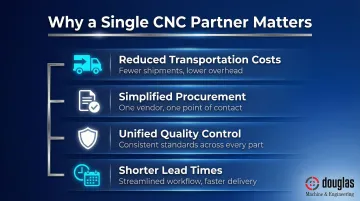
A manufacturer that handles the full project lifecycle—from design and CNC machining through finishing, assembly, and delivery—eliminates the need to coordinate multiple vendors. Consolidating processes with a single partner:
- Reduces transportation costs by eliminating multiple shipments between suppliers
- Eliminates multiple purchase orders and invoice reconciliations
- Keeps quality control in one set of hands with unified accountability
- Shortens lead times by removing handoff delays
DM&E's concept-to-installation model puts this into practice: design engineering, CNC machining (components up to 20,000 lbs with tolerances from ±0.005" to ±0.0005"), specialty welding, assembly, and finishing through qualified partners — all coordinated under a single project management structure.
Communication and Project Management
On complex programs with tight deadlines or evolving specifications, communication practices make or break the partnership. Look for suppliers who:
- Assign dedicated project managers to your account
- Provide regular status updates without prompting
- Proactively flag potential issues before they impact schedule
- Maintain open-door policies for technical discussions
When design changes or production challenges arise, suppliers with these habits resolve issues through direct conversation — not formal escalation chains that cost time.
Frequently Asked Questions
What does CNC mean in machining?
CNC stands for Computer Numerical Control—machine tools are operated by pre-programmed computer commands rather than manual input. This enables automated, precise, and repeatable machining operations with minimal human intervention once programs are verified.
What is a CNC machine used for?
CNC machines cut, shape, drill, and finish parts from metal, plastic, and other materials. They serve industries from aerospace and defense to pharmaceutical, food packaging, agriculture, and robotics—anywhere precise, repeatable parts are required at scale.
What materials can CNC machines work with?
CNC machines process aluminum, stainless steel, brass, copper, titanium, steel alloys, and engineering plastics including Delrin, PEEK, and nylon. Material choice depends on the application — aerospace parts typically use titanium or aluminum alloys, while pharmaceutical equipment commonly requires 316L stainless steel.
What is the difference between CNC milling and CNC turning?
In milling, the cutting tool rotates and moves around a stationary workpiece—best for complex prismatic shapes with pockets, slots, and contours. In turning, the workpiece rotates against a stationary tool—best for cylindrical or round parts like shafts and bushings.
How accurate is CNC machining?
High-precision CNC machines achieve tolerances as tight as ±0.0002 inches — tight enough for aerospace, medical, and defense parts where dimensional accuracy directly affects safety and function. Standard commercial tolerances typically range from ±0.005" to ±0.001" depending on part geometry and material.
What industries use CNC manufacturing?
Key sectors include aerospace, defense, pharmaceutical, food grade packaging, agricultural equipment, robotics, construction, and general industrial manufacturing — any application requiring precise, repeatable parts at scale.