Introduction
Steel beams holding up skyscrapers, precision housings inside medical devices, stainless steel equipment in food processing plants — all of it starts the same way: raw metal shaped through fabrication. It's one of the most foundational manufacturing disciplines in modern industry.
Metal fabrication combines design engineering, material science, and precision machining to produce everything from 20-ton structural assemblies to components with tolerances measured in ten-thousandths of an inch. The scope runs far wider than most people assume.
This guide covers:
- The formal definition of metal fabrication
- The three primary types: industrial, structural, and commercial
- The most common fabrication methods
- Key materials and their applications
- Industries that depend on fabrication
- What to evaluate when selecting a fabrication partner for aerospace, defense, food-grade, or industrial programs
What Is Metal Fabrication?
Metal fabrication is the process of transforming raw metal stockinto finished parts, components, or structures through cutting, forming, and assembling. Raw inputs include sheet metal, plate, bar stock, tubing, and castings. Unlike a single manufacturing technique, it's a value-added process that moves raw materials through multiple operations until they're ready for installation or final assembly.
The Three-Phase Fabrication Workflow:
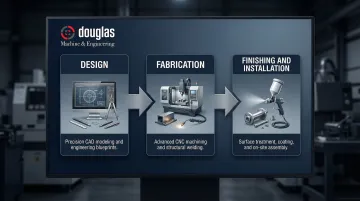
Most custom fabrication projects follow a standard three-phase sequence:
Design: Engineers develop drawings and specifications using CAD software — PTC Creo, CATIA v5, or AutoCAD are common tools. This phase translates customer requirements into manufacturable designs with defined dimensions, tolerances, and material callouts.
Fabrication: Skilled fabricators cut, shape, and join raw materials using CNC machines, press brakes, welding systems, and more. This is where metal stock becomes functional components.
Finishing and Installation: Surface treatments such as powder coating and grinding are applied, components are assembled into their final form, and on-site installation or validation follows.
Fabrication vs. Manufacturing vs. Welding:
Metal fabrication focuses specifically on creating parts and structures from raw metal stock, while manufacturing more broadly refers to assembling those finished parts into consumer goods or equipment. Welding is one joining process within fabrication—not a synonym for it. A fabrication shop may perform dozens of processes (cutting, bending, machining, welding, finishing), while a welding shop specializes in joining operations alone.
Key Takeaways
- Metal fabrication transforms raw metal into usable parts through cutting, forming, and assembly techniques
- Three primary types — industrial, structural, and commercial — serve different production scales and end uses
- Core processes span laser cutting, CNC machining, welding, casting, bending, and surface finishing
- Steel dominates the market at 63.2% of North American fabricated metal products, though aluminum is growing at 6.21% annually
- Choosing the right fabrication partner means evaluating certifications, full-service capabilities, and sector-specific experience
The Three Types of Metal Fabrication
Metal fabrication breaks into three broad categories: industrial, structural, and commercial. Each serves different end uses, operates under different standards, and demands different capabilities from a fabrication partner. Custom work often spans more than one category — knowing the differences helps you spec projects accurately from the start.
Industrial Metal Fabrication
Industrial metal fabrication produces large-scale parts and assemblies integrated into industrial equipment and machinery—such as heavy machine components, tanks, silos, pressure vessels, and production tooling. These parts typically serve as inputs to other production processes rather than end-consumer products.
Key characteristics:
- Component weights ranging from hundreds to thousands of pounds
- Tight tolerances (±0.005" to ±0.0005") for mating surfaces and precision assemblies
- Material traceability and certifications required for regulated industries
- Long production runs with documented quality systems
Industries served: Aerospace and defense, energy, material handling, robotics, food processing equipment, and pharmaceutical manufacturing equipment.
Structural Metal Fabrication
Structural fabrication creates load-bearing components used in construction and infrastructure projects—including I-beams, trusses, girders, platforms, stairs, and building frames. Steel dominates this category due to its superior strength-to-weight ratio; steel bridges make up 36% of the U.S. national bridge inventory, totaling 208,422 bridges.
Real-world examples:
- Skyscraper frameworks and commercial building structures
- Highway bridges and pedestrian overpasses
- Industrial platforms and mezzanines
- Warehouse racking systems
Governing standards: Structural steel fabrication is governed by the American Institute of Steel Construction (AISC) 360 specification and the American Welding Society (AWS) D1.1 Structural Welding Code, which mandate design calculations, weld procedures, and inspection protocols.
Commercial Metal Fabrication
Commercial fabrication produces smaller, more precise metal parts installed in commercial environments—including guardrails, shelving systems, stainless steel sinks, awnings, conveyors, and decorative metalwork. Finish quality and code compliance carry more weight here than in the other two categories.
Key characteristics:
- Aesthetic finishes (powder coating, polishing, plating)
- Tighter dimensional tolerances for fit and finish
- Corrosion-resistant materials (stainless steel, aluminum)
- Compliance with fire codes, accessibility standards, and sanitary regulations
Common Metal Fabrication Processes and Methods
Metal fabrication draws on a range of techniques, each selected based on metal type, part geometry, tolerance requirements, and production volume.
Cutting
Cutting is typically the first step in fabrication, dividing raw metal stock into workable pieces. The method selected depends on material thickness, precision requirements, and thermal sensitivity.
Common cutting methods:
| Process | Tolerance | Max Thickness (Steel) | Key Advantage |
|---|---|---|---|
| Fiber Laser | ±0.03 to ±0.1 mm | Up to 25 mm | High precision, minimal heat-affected zone |
| Plasma Cutting | ±0.25 to ±0.5 mm | Up to 50 mm | Fast speeds for thick plate |
| Waterjet | ±0.08 to ±0.13 mm | Up to 610 mm | No heat input, suitable for heat-sensitive materials |
| Shearing | ±0.125 to ±1.5 mm | Up to 6.35 mm | Fast straight-line cuts on sheet metal |
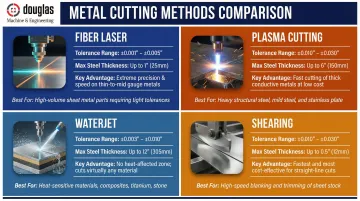
CNC-controlled cutting systems deliver repeatable accuracy essential for aerospace and defense applications where part-to-part consistency is critical.
Forming and Bending
Forming processes reshape metal without removing material, using mechanical force to create angles, curves, and complex profiles.
Four core forming methods each serve different geometries and applications:
- Press brake bending — A punch and die form angles in sheet metal. In air bending, punch depth determines the bend angle; die-opening width controls the inside radius and tonnage requirements.
- Roll forming — Flat strip feeds through successive paired roller dies, incrementally bending the metal to minimize strain and compensate for springback. Best suited for long, consistent profiles such as channels, angles, and tubes.
- Tube bending — Uses rotary draw bending with a bend die, clamp die, and pressure die. A mandrel inside the tube prevents wall collapse; a wiper die prevents wrinkling on the inside radius.
- Deep drawing — A blankholder constrains a flat blank while a punch pushes the center into a die opening, drawing the metal into a hollow shape without wrinkles or splits.
Welding and Assembly
Welding fuses two metal pieces together at the joint using heat, with or without filler material. It is a core assembly technique in fabrication—not synonymous with fabrication itself.
Common welding types:
- MIG (GMAW) — Uses continuously fed wire, offering high speeds and ease of use for production welding
- TIG (GTAW) — Uses a non-consumable tungsten electrode, providing high-quality, precise welds ideal for thin sheets and critical joints
- Stick (SMAW) — Uses consumable coated electrodes, offering versatility for field work and thick materials
- Robotic welding — Uses seam tracking technology to follow weld positions in real-time, improving path accuracy and consistency
Quality assurance: In aerospace and defense applications, weld integrity directly affects structural performance and safety. AWS-certified welders — a credential DM&E holds — provide the documented quality and consistency these industries require.
Machining
Machining removes material from a metal workpiece using cutting tools to achieve precise dimensions and surface finishes. CNC (Computer Numerical Control) machining is the modern standard—CNC machines translate digital designs (CAD/CAM files) into precise, repeatable cuts.
Why CNC matters for aerospace and defense:
Aerospace and defense parts demand extremely tight tolerances—often ±0.0005" or better—where manual machining cannot deliver the required consistency. ISO 2768-1 Fine Class tolerances specify ±0.05 mm for precision mating surfaces, which CNC systems achieve through programmed tool paths and real-time feedback.
DM&E's new CNC machining production shop expands capacity for high-precision, high-volume work, machining components up to 20,000 lbs with tolerances from ±0.005" to ±0.0005".
Casting and Forging
Casting pours molten metal into a mold to form complex shapes. Investment casting uses a disposable wax pattern surrounded by ceramic slurry to create intricate geometries, requiring minimal secondary machining. Die casting injects molten metal into a permanent metal die under high pressure, ideal for high-volume production.
Forging compresses heated metal under extreme force to improve grain structure and strength. Forging offers superior structural integrity and zero porosity compared to castings, making it preferred for high-stress components like landing gear and turbine shafts.
The choice between casting and forging typically comes down to geometry complexity versus strength requirements — casting wins on shape versatility, forging on mechanical performance.
Finishing
Finishing processes protect against corrosion, improve aesthetics, and meet regulatory or functional requirements.
Common finishing methods:
- Sandblasting — Removes surface defects and prepares metal for coating adhesion
- Powder coating — Applies thermoset finishes (epoxy, polyester, nylon) that provide corrosion, UV, and abrasion resistance
- Painting — Liquid coatings for larger structures or specific color matching
- Surface grinding — Achieves precise flatness and surface roughness specifications
In regulated industries (food-grade packaging, pharmaceutical), specific surface finishes are required for hygiene compliance. FDA 21 CFR 110.40 and 3-A Sanitary Standards dictate that product contact surfaces must achieve a maximum surface roughness of 32 µin (0.8 µm) Ra, typically achieved via a No. 4 ground finish.
Common Raw Materials in Metal Fabrication
Steel remains the dominant material in metal fabrication. The global steel market was valued at USD 1.49 trillion in 2025, reflecting its widespread use across construction, automotive, energy, and industrial sectors. In North America, steel captured 63.2% of the fabricated metal products market share in 2024 — though aluminum is closing the gap, growing at a 6.21% CAGR driven by lightweighting demands in EV and aerospace applications.
Material Properties Comparison
The table below compares the five most common fabrication metals by grade, tensile strength, density, and key attribute:
| Material | Typical Grade | Tensile Strength | Density (g/cc) | Key Fabrication Attribute |
|---|---|---|---|---|
| Carbon Steel | ASTM A36 | 400–550 MPa | 7.85 | Excellent weldability, structural strength |
| Stainless Steel | 316 | 580 MPa | 8.00 | High pitting/crevice corrosion resistance |
| Aluminum | 6061-T6 | 310 MPa | 2.70 | High strength-to-weight, good workability |
| Titanium | Ti-6Al-4V | 950 MPa | 4.43 | Extreme strength, biocompatibility |
| Copper | C11000 (ETP) | 220 MPa | 8.89 | 101% IACS electrical conductivity |
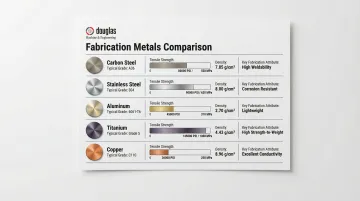
Material selection drivers:
- Mechanical properties — Strength, hardness, ductility, fatigue resistance
- Environmental conditions — Corrosion resistance, temperature tolerance, chemical exposure
- Regulatory requirements — Food-grade (316 stainless), aerospace-grade (certified titanium), medical (biocompatible alloys)
- Cost and availability — Lead times, market pricing, supply chain stability
Raw Stock Forms
Fabricators work with several raw stock forms, each suited to different processes:
- Sheet metal — Flat, thin material (under 6 mm / 0.25") for cutting and bending
- Plate metal — Thicker material (6 mm and above) for structural and heavy industrial parts
- Bar and tube stock — Used for frames, structural members, and bending applications
- Castings and forgings — Used as blanks for precision machining
The choice of stock form directly affects which fabrication methods are applicable. Sheet metal suits laser cutting and press brake bending, while plate requires plasma cutting or waterjet. Tube stock enables roll forming and rotary draw bending.
Industries That Rely on Metal Fabrication
Metal fabrication underlies nearly every major industrial sector. The global contract fabrication services market was valued at USD 444.9 billion in 2025 and is projected to reach USD 795.2 billion by 2033, growing at a 7.6% CAGR, driven by infrastructure renewal, aerospace expansion, and industrial automation.
Key sectors and their requirements:
Aerospace and Defense — Requires certified processes, documented material traceability, and AS9100D-compliant quality systems. NADCAP accreditation covers special processes like heat treating, NDT, and welding.
Agricultural Equipment — Heavy-plate cutting, robotic welding, and corrosion-resistant coatings for tractors, combines, and harvesting equipment.
Robotics — Tight-tolerance structural frames, actuator housings, and mounting brackets built for repeatable accuracy in automated assembly.
Food-Grade Packaging and Pharmaceutical — 3-A Sanitary Standards require AISI 300 series stainless steel on product-contact surfaces. FDA/USDA compliance drives both material selection and surface finish requirements.
Construction — Structural steel frameworks, platforms, stairs, and building systems. U.S. fabricated structural metal manufacturing is projected to hit $65.5 billion by 2026, fueled by federal infrastructure programs.
Industrial/Manufacturing — Custom machinery components, tooling, material handling equipment, and production fixtures.
Each sector brings its own standards, material constraints, and certification demands. A fabricator experienced across aerospace, food-grade, and agricultural work — like DM&E, which holds both ISO 9001:2015 and AS9100D certifications and employs AWS-certified welders — brings compliance knowledge that generalist shops simply don't carry.
How to Choose the Right Metal Fabrication Partner
Not all fabrication shops are equal—the right partner depends on matching their capabilities to the project's complexity, tolerances, material requirements, and regulatory environment.
Certifications and Quality Systems
ISO 9001:2015 signals a documented quality management system built on process discipline, risk-based thinking, and continual improvement (PDCA)—the baseline for any shop handling regulated work.
AS9100D is the aerospace and defense industry standard—indicating the shop meets rigorous requirements for quality, traceability, and process control. AS9100D adds aerospace-specific requirements including human factor consideration, counterfeit parts prevention, and operational risk management.
AWS certifications provide assurance that welding meets established standards:
- AWS QC17 (Certified Welding Fabricator) — Verifies the facility has the personnel, procedures, and equipment to conduct proper weldments
- AWS QC7 (Certified Welder) — Proves individual welders have passed performance qualification tests for specific processes and positions
- AWS QC1 (Certified Welding Inspector) — Certifies visual welding inspectors to determine if weldments meet code acceptance criteria
DM&E holds ISO 9001:2015, AS9100D, and AWS certifications—the quality infrastructure required for aerospace, defense, and regulated industry work where documented procedures and material traceability aren't optional.
Full-Service vs. Single-Process Capability
Working with a partner who can manage the entire project lifecycle—from design and engineering through fabrication and installation—cuts costs and reduces delays compared to coordinating multiple vendors.
Benefits of single-source fabrication:
- Components move through one coordinated workflow, cutting shipping costs between vendors
- One purchase order replaces multiple vendor relationships, reducing administrative overhead
- Quality accountability stays with a single shop from start to finish
- Fragmented multi-vendor projects run 30-40% longer than integrated turnkey solutions
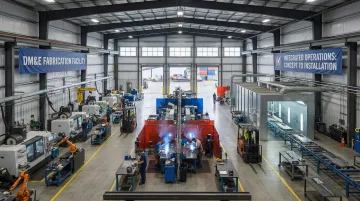
DM&E's concept-to-installation model provides in-house design engineering, CNC machining, welding, fabrication, and finishing, while coordinating specialty processes (heat treatment, plating) through qualified suppliers. One shop owns the outcome—no handoffs, no finger-pointing between vendors.
Project Management and Communication
A fabricator's ability to manage timelines, coordinate with specialty subcontractors, provide transparent status updates, and resolve issues proactively is as important as their technical capabilities.
What to evaluate:
- A single point of contact who owns the program from kickoff through delivery
- Regular updates on progress, scope changes, and potential delays—before they become problems
- Clear escalation paths with documented corrective actions when issues arise
- Tracked delivery schedules with defined recovery plans if timelines slip
On-time delivery and clear communication are especially critical for aerospace and defense program schedules where delays cascade through multi-tier supply chains.
Experience in Your Sector
Fabricators with demonstrated experience in a buyer's specific industry—whether aerospace, food-grade, or industrial—understand applicable standards, material specifications, and inspection requirements.
Questions to ask:
- What similar projects have you completed in our industry?
- Which industry-specific certifications or approvals do you hold?
- Do you have SAM registration and a CAGE code for government contracting?
- Can you provide customer references or case studies?
For federal contracting, a valid SAM.gov registration and Defense Logistics Agency (DLA) issued CAGE code are absolute prerequisites. DM&E holds SAM registration, CAGE Code 87BF4, and JCP approval, demonstrating eligibility and qualification for defense and government procurement programs.
Frequently Asked Questions
What is metal fabrication?
Metal fabrication is the process of creating parts, components, or structures from raw metal materials through cutting, forming, and assembling. It encompasses multiple processes—laser cutting, bending, welding, machining, finishing—rather than a single operation, transforming raw stock into engineered products ready for installation or assembly.
Is metal fabrication the same as welding?
No. Welding is one joining process within the broader field of metal fabrication. Fabrication encompasses many processes—cutting, bending, machining, finishing—of which welding is just one component.
What is an example of metal fabrication?
Common examples across fabrication types include:
- Aerospace: Aircraft fuselage panels requiring tight tolerances and material traceability
- Structural: Steel building frames governed by AISC specifications
- Commercial/Food-grade: Stainless steel conveyors requiring sanitary finishes and corrosion resistance
What are the three types of metal fabrication?
The three primary types are:
- Industrial: Large-scale machinery and equipment parts for manufacturing and aerospace
- Structural: Load-bearing construction components like beams, trusses, and building frames
- Commercial: Precision parts for commercial spaces, emphasizing aesthetics and regulatory compliance
What is a production fabricator?
A production fabricator is a shop that manufactures the same component repeatedly at scale, as opposed to one-off or prototype work. They typically rely on CNC automation, robotic welding, and documented quality systems to maintain consistency across high-volume runs.
What's the difference between production and fabrication?
Fabrication refers to the process of shaping raw metal into parts using cutting, forming, and joining techniques. Production refers to the volume and rate at which those parts are manufactured. The two terms often overlap, but fabrication describes the method and production describes the output scale.