What Is Metal Works Welding and Fabrication?
Metal fabrication is the process of transforming raw metal into functional parts, assemblies, or structures through cutting, forming, and welding — and welding is the joining force that holds fabricated assemblies together. From aerospace components in commercial aircraft to structural beams in manufacturing facilities, these techniques support sectors as diverse as defense, agriculture, robotics, pharmaceutical equipment, food-grade packaging, construction, and heavy industrial machinery.
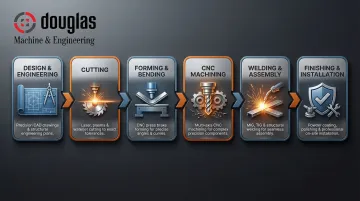
The production workflow follows a clear progression: design and engineering → cutting and forming → welding and assembly → finishing → installation. Understanding each stage helps buyers, engineers, and project managers identify quality issues earlier and select fabrication partners capable of delivering on time and to specification.
Demand is accelerating. Infrastructure investment, aerospace expansion, and industrial automation are all driving sustained growth in fabrication capacity — which means more competition among suppliers and higher stakes when selecting a manufacturing partner.
TLDR:
- Metal fabrication transforms raw metal through cutting, forming, welding, and finishing into functional components
- Welding is the critical joining process that holds fabricated assemblies together across industries
- Each stage — from design through installation — directly affects final quality
- Qualified fabrication partners with proper certifications reduce risk and ensure compliance
- The global market continues expanding due to aerospace, infrastructure, and automation demand
Core Welding Techniques Used in Metal Fabrication
Choosing the wrong welding process can compromise weld strength, surface finish, and compliance with industry standards. Each of the four primary methods below suits specific materials, thicknesses, and environments — knowing the differences lets engineers and procurement teams specify the right process from the start.
MIG Welding (GMAW)
Metal Inert Gas (MIG) welding, technically known as Gas Metal Arc Welding (GMAW), uses a consumable wire electrode continuously fed through a welding gun, surrounded by a shielding gas that protects the weld pool from atmospheric contamination. The process offers several key advantages:
- Delivers high deposition rates that keep production lines moving
- Shorter learning curve than TIG, reducing training time for new welders
- Handles 18-gauge to 1/2-inch thickness across carbon steel, stainless, and aluminum
- Produces minimal spatter with properly dialed-in parameters
MIG welding dominates automotive fabrication, agricultural equipment manufacturing, and general industrial metalworking. It's the default choice when speed and cost-effectiveness drive the decision — provided material thickness stays within range.
TIG Welding (GTAW)
Tungsten Inert Gas (TIG) welding, or Gas Tungsten Arc Welding (GTAW), uses a non-consumable tungsten electrode to create the arc, with filler metal added separately by hand. This produces cleaner, more precise welds than MIG:
- Precise heat and filler control produces smooth welds with minimal post-weld finishing
- Low contamination risk meets strict standards for food-grade, pharmaceutical, and aerospace work
- Welds exotic alloys — titanium, Inconel, duplex stainless — that other processes handle poorly
- Preferred when weld appearance is a functional requirement, not just cosmetic
Aerospace components, pharmaceutical equipment, and food-grade stainless fabrications typically specify TIG to meet strict cleanliness and quality standards. The tradeoff is speed: TIG is significantly slower than MIG or FCAW, making it a deliberate choice rather than a default.
Stick Welding (SMAW)
Shielded Metal Arc Welding (SMAW), commonly called stick welding, uses a consumable electrode coated with flux that creates a protective gas shield as it burns. It's built for conditions where other processes struggle:
- Minimal equipment makes it practical for remote field work
- Tolerates wind and outdoor conditions that would disrupt MIG or TIG shielding gas
- Welds through rust, paint, and mill scale without extensive surface prep
- Achieves deep penetration on thicker structural sections
Stick welding is standard in structural steel construction, pipeline work, and heavy industrial maintenance — situations where portability and surface tolerance outweigh the need for speed or a clean finish.
Flux-Core Arc Welding (FCAW)
Flux-Cored Arc Welding uses a tubular wire filled with flux, enabling faster welding speeds and better penetration on thicker materials. FCAW comes in two variants: self-shielded (no external gas required) and gas-shielded (uses CO2 or mixed gases):
- Outpaces MIG on deposition rates for materials 1/4-inch and thicker
- Achieves deep penetration suited to heavy structural assemblies
- Self-shielded variant performs in outdoor and windy environments
- Reduces passes needed on thick sections, cutting total weld time
Heavy structural fabrication, shipbuilding, and outdoor construction projects rely on FCAW precisely because it handles thick material efficiently — without the speed penalty that TIG or even MIG would impose at that scale.
Quick-Reference Comparison
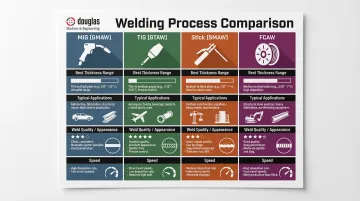
| Process | Best Thickness Range | Typical Applications | Weld Quality/Appearance | Speed |
|---|---|---|---|---|
| MIG (GMAW) | 18-gauge to 1/2" | Automotive, agricultural, general industrial | Good quality, minimal cleanup | Fast |
| TIG (GTAW) | Thin to 1/4" | Aerospace, pharmaceutical, food-grade | Excellent quality, superior aesthetics | Slow |
| Stick (SMAW) | 1/8" and up | Structural, field work, maintenance | Fair quality, requires cleanup | Moderate |
| FCAW | 1/4" and up | Heavy structural, shipbuilding, outdoor | Good quality, some spatter | Very fast |
Key Metal Fabrication Processes: From Raw Stock to Finished Part
Welding is just one step in a complete fabrication workflow. Multiple upstream and downstream processes determine the precision, strength, and surface quality of the finished component. Understanding these processes helps buyers evaluate whether a fabrication partner can truly deliver turnkey solutions or will require multiple vendor handoffs.
Cutting
Modern fabrication shops employ several cutting methods, each suited to specific materials, thicknesses, and precision requirements:
- Laser cutting: Delivers high precision and handles complex geometries on thin to medium thickness materials (up to 1 inch for most systems). Ideal when tight tolerances and intricate shapes are required
- Plasma cutting: Offers speed and cost efficiency on thicker metals (1/4-inch to 2-inch range). Best choice for structural steel and high-volume production
- Waterjet cutting: Produces no heat-affected zone, making it ideal for heat-sensitive materials, composites, and materials where thermal distortion is unacceptable
- Shearing: Provides fast, economical straight cuts on sheet metal. Limited to simple geometries but extremely efficient for blanking and trimming operations
Selecting the right cutting method affects downstream processes — laser-cut edges typically require minimal preparation before welding, while plasma-cut edges may need grinding to remove dross.
Forming and Bending
Press brakes, roll forming, and stamping transform flat metal stock into angles, channels, tubes, and complex profiles. These forming operations create the basic shapes that welding later joins into assemblies:
- Press brake bending: Creates precise angles and bends in sheet metal using programmable CNC press brakes
- Roll forming: Produces consistent profiles (tubes, channels, angles) in continuous lengths
- Stamping: Forms complex shapes and features in high-volume production runs
Tight tolerances in forming directly affect downstream fit-up and weld quality. Poorly formed parts create gaps that require excessive filler metal, compromise weld strength, and increase labor costs during assembly.
CNC Machining
CNC milling, turning, and drilling produce high-precision features, holes, threads, and mating surfaces that cannot be achieved through forming alone. Fabrication shops with in-house CNC capabilities — like DM&E's newly expanded CNC production shop — can control quality across the full production cycle without outsourcing:
- Milling: Creates flat surfaces, pockets, slots, and complex 3D geometries
- Turning: Produces cylindrical features, threads, and precision diameters
- Drilling/tapping: Adds holes and threads for fasteners and assembly
In-house machining eliminates the delays, transportation costs, and quality risks associated with sending parts to external machine shops between fabrication stages.
Assembly and Finishing
Once machined components meet dimensional specs, they move into assembly — fit-up, tack welding, and final welding to create permanent joints. From there, finishing processes protect against corrosion and meet industry-specific requirements:
- Powder coating: Provides durable, corrosion-resistant finishes in various colors
- Painting: Offers aesthetic and protective coatings for large assemblies (coordinated through DM&E's supplier network as part of project management)
- Anodizing: Creates corrosion-resistant oxide layers on aluminum components
- Passivation: Removes free iron from stainless steel surfaces to maximize corrosion resistance
Finishing requirements vary by industry — food-grade applications may require electropolished stainless surfaces, while aerospace components often specify specific primer and paint systems for corrosion control.
Having all these processes under one roof delivers three concrete advantages: shorter lead times without transportation delays between vendors, fewer handoff errors when a single shop interprets drawings from start to finish, and lower costs through consolidated logistics and project management.
The Three Types of Metal Fabrication
Metal fabrication falls into three main categories, each with distinct characteristics, quality requirements, and typical applications. Understanding these distinctions helps buyers communicate requirements clearly and select fabrication partners with relevant experience.
Industrial Metal Fabrication
Large-scale components for demanding applications — tanks, silos, machine parts, material handling equipment, and specialized manufacturing systems. Aerospace, agriculture, and energy sectors are the primary buyers.
Key requirements:
- AWS-certified welders and documented welding procedures
- Rigorous inspection protocols at each production stage
- High strength specifications with traceability documentation
Structural Metal Fabrication
Load-bearing elements for construction and industrial infrastructure: beams, trusses, platforms, stairs, mezzanines, and building frameworks. This category carries the strictest regulatory burden.
Key requirements:
- Compliance with AWS D1.1 Structural Welding Code
- Engineer-stamped drawings for all assemblies
- Independent weld inspection before installation approval
Commercial Metal Fabrication
Precision-finished parts for commercial environments — guardrails, shelving systems, display fixtures, conveyors, and architectural metalwork. Regulatory requirements are generally lighter than structural or industrial work, but aesthetic and fit standards are high.
Key requirements:
- Tight dimensional tolerances for proper fit and function
- Clean finish quality for visible architectural elements
- Safety compliance for public-facing installations
Selecting the Right Metal for Your Fabrication Project
Material selection directly affects weldability, strength, weight, corrosion resistance, and cost. The wrong material choice can lead to weld cracking, premature failure, or non-compliance with industry specifications. Three metals dominate fabrication work, each with distinct characteristics.
Carbon and Mild Steel
Carbon and mild steel remains the most widely used fabrication material due to cost-effectiveness, excellent weldability, and broad availability. Mild steel (typically containing less than 0.3% carbon) welds easily with all common processes and provides good strength for structural and general industrial applications. Its primary limitation is corrosion susceptibility, requiring protective coatings in most environments.
Stainless Steel
Stainless steel offers superior corrosion resistance, making it essential for food-grade, pharmaceutical, and chemical processing applications. The most common grades — 304 and 316 — maintain reasonable weldability, but the material demands more skill to weld properly. Controlling heat input prevents carbide precipitation and preserves corrosion resistance. Stainless costs more upfront than carbon steel but eliminates ongoing maintenance and coating expenses.
Aluminum
Aluminum provides an excellent strength-to-weight ratio, making it the preferred choice for aerospace, robotics, and applications where weight reduction matters. It requires TIG welding or specialized MIG equipment with proper shielding gases. High thermal conductivity demands different technique than steel, and welders must properly manage surface oxides to achieve sound welds.
According to industry data, carbon and mild steel account for approximately 70-75% of fabricated metal products, with stainless steel and aluminum splitting most of the remainder.
Specialty alloys — titanium, Inconel, duplex stainless — are increasingly specified in aerospace and defense applications where extreme environments demand exceptional performance. These materials require certified welders with demonstrated procedure qualification; even minor deviations from approved welding parameters can compromise structural integrity.
Quality Standards and Certifications in Metal Fabrication
Certifications are not administrative checkboxes — they represent documented, audited systems ensuring that every weld, every cut, and every finished part meets defined standards. Industries like aerospace and defense contractually require specific certifications from their suppliers, making these credentials essential for market access.
AWS-Certified Welders
The American Welding Society (AWS) Certified Welder program provides nationally recognized, performance-based credentials for industrial welders. According to AWS documentation, certifications are administered through AWS Accredited Test Facilities (ATFs) under strict quality standards, with Certified Welding Inspectors (CWIs) evaluating welder performance.
Welders are tested against rigorous industrial codes — AWS D1.1 for structural steel, API 1104 for pipelines, ASME Section IX for pressure piping — using visual, mechanical, and radiographic inspection methods. Each certification is tightly scoped:
- Process: Limited to the method tested (MIG, TIG, Stick, or FCAW)
- Material and thickness: Valid only within the range evaluated
- Position: Restricted to the specific weld position tested
- Ongoing validity: Welders must submit documentation every six months proving continuous use of the qualified process
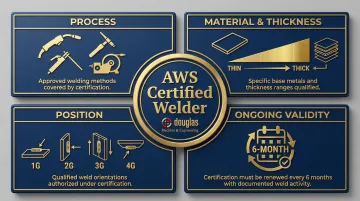
DM&E employs AWS-certified welders, ensuring weld quality meets industry standards for demanding aerospace, defense, and industrial applications.
ISO 9001:2015 Quality Management
ISO 9001:2015 establishes quality management system requirements covering all aspects of manufacturing operations:
- Documented procedures for all critical processes
- Personnel qualification and training requirements
- Calibration and maintenance of inspection equipment
- Nonconforming product identification and disposition
- Continuous improvement through corrective and preventive action
ISO 9001:2015 certification demonstrates that a fabricator maintains consistent processes, documents procedures, and systematically addresses quality issues. DM&E holds ISO 9001:2015 certification, which means audit-ready documentation and traceable process controls are in place before a job ever reaches the shop floor.
AS9100D Aerospace Quality Standard
AS9100D layers aerospace-specific requirements on top of ISO 9001:2015, creating the quality standard required for defense and aviation supply chains. Additional requirements include:
- Configuration management and change control
- First article inspection (FAI) reporting
- Material traceability and certification
- Supplier approval and flow-down requirements
- Risk management and product safety protocols
DM&E holds AS9100D certification, making them qualified for aerospace and defense fabrication programs requiring the highest quality standards. For buyers managing defense or aviation supply chains, AS9100D qualification means DM&E can accept flow-down requirements directly and maintain the configuration control those programs demand.
Additional Compliance Markers
Buyers evaluating fabricators should also verify three supporting documentation types — especially for government and defense contracts:
- Mill certifications: Confirm material chemistry and mechanical properties from the source
- Weld Procedure Specifications (WPS): Document the approved welding parameters for each qualified process
- Traceability records: Link finished components back to source materials and specific production records
DM&E maintains government contracting credentials including SAM approval, JCP approval, and CAGE code 87BF4, enabling participation in federal procurement programs and defense supply chains.
Choosing the Right Metal Fabrication and Welding Partner
Selecting a fabrication partner requires evaluating capabilities, certifications, industry experience, and operational approach. Key criteria include:
- In-house capabilities across all processes — cutting, forming, machining, welding, and finishing under one roof simplifies vendor management and keeps quality control consistent throughout.
- Certifications matched to your industry — AS9100D for aerospace/defense, ISO 9001:2015 for general manufacturing, AWS-certified welders for critical weld applications.
- Proven experience in your sector — fabricators who know your industry understand material preferences, regulatory requirements, and what "acceptable quality" actually means. Ask for project references.
- Active project management — the best partners coordinate specialized processes and outside suppliers while keeping you informed, so you're not chasing updates across multiple vendors.
- Design-to-installation capability — partners who can engage during the design phase often identify manufacturability issues before they become costly rework problems.
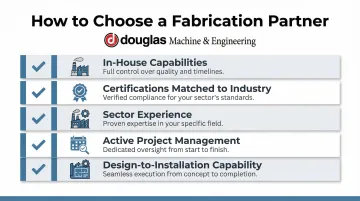
Working with a single-source partner cuts costs by eliminating duplicate handling and transportation. It also compresses timelines — no handoff delays, no gaps in quality oversight between vendors.
DM&E operates as a full-service fabrication partner for aerospace, defense, agricultural, robotics, food-grade, pharmaceutical, and industrial customers. In-house capabilities include design engineering (PTC Creo, CATIA, AutoCAD), CNC machining, AWS-certified welding, and powder coating, with coordinated project management for processes like plating that extend beyond the shop floor. ISO 9001:2015 and AS9100D certifications back that up at every stage, from initial concept through final installation.
Frequently Asked Questions
What are the three types of metal fabrication?
Metal fabrication breaks into three main categories:
- Industrial: Large-scale components for heavy industries like aerospace and material handling
- Structural: Load-bearing construction elements — beams, trusses, and columns — governed by building codes
- Commercial: Precision parts for commercial use, including fixtures, shelving, and conveyor systems
Do you need a license for metal fabrication?
General metal fabrication typically doesn't require a business license beyond standard permits. However, welders often need AWS or other certifications depending on the industry and application — particularly for aerospace, defense, pressure vessels, and structural work where code compliance is mandatory.
What is the difference between welding and metal fabrication?
Metal fabrication is the complete process of creating a finished metal product through cutting, forming, machining, assembly, and finishing. Welding is one specific joining technique used within the broader fabrication process to permanently attach components.
What certifications should a metal fabrication company have?
Key certifications to look for include ISO 9001:2015 for quality management, AWS-certified welders for consistent weld quality, and AS9100D for aerospace and defense work. For regulated industries, material traceability documentation and government registrations — such as SAM approval and a CAGE code — are also required.
What metals are most commonly used in fabrication and welding?
Carbon and mild steel, stainless steel, and aluminum account for over 90% of fabricated products. Engineers select each based on the application's demands — strength, corrosion resistance, weight, and how well the material welds.