Introduction
Companies in aerospace, defense, pharmaceuticals, and industrial sectors often need precision-manufactured components that meet exacting specifications—but lack the equipment, certifications, or workforce to produce them in-house. Building that capability requires substantial capital investment in CNC machines, welding equipment, and quality systems. Before a single part is produced, costs can reach hundreds of thousands of dollars.
Contract manufacturing solves this by letting companies outsource production to specialized third-party manufacturers who already have the equipment, certifications, and expertise. This article covers what contract manufacturing is, the main service types, how the process works, the business benefits, and what to look for in a manufacturing partner.
TLDR:
- Contract manufacturing delegates production to specialized third parties while you retain design ownership and brand control
- Services range from individual precision components to complete turnkey assemblies with full project management
- The model eliminates capital investment in equipment and facilities while providing access to certified expertise
- The global contract manufacturing market is projected to reach $966.84 billion by 2030, growing at 5.98% annually
- Choosing the right partner comes down to certifications, proven capacity, and clear communication
What Is Contract Manufacturing?
Contract manufacturing is a business arrangement in which a company delegates the production of components, subassemblies, or finished products to a specialized third-party manufacturer. The hiring company retains full ownership of the design, intellectual property, and brand while the contract manufacturer handles the physical production, quality control, and delivery.
How the Process Works in Practice
The process typically begins when a company approaches a contract manufacturer with engineering drawings, CAD files, or detailed specifications. The manufacturer reviews the requirements, assesses feasibility, and provides a quote covering materials, labor, tooling, and timeline. Once terms are agreed, the manufacturer procures materials, sets up production, executes manufacturing and quality inspections, and delivers finished goods to the client's specifications.
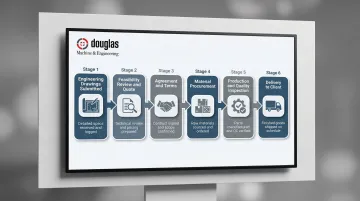
Some contract manufacturers—like DM&E—offer comprehensive design support that takes projects from initial concept through installation. This means companies without finalized drawings can partner with a manufacturer who provides in-house engineering to develop specifications, establish manufacturing processes, and deliver finished products entirely under one roof.
Contract Manufacturing vs. Off-the-Shelf Products
The critical distinction between contract manufacturing and purchasing standard products is customization. Contract manufacturing means production is tailored to your exact specifications, tolerances, materials, and quality requirements. You're not selecting from a catalog—you're having parts manufactured specifically for your application, whether that's a precision-machined aerospace component with ±0.0005" tolerances or a welded structural assembly built to your proprietary design.
Why Businesses Choose This Model
Companies choose contract manufacturing to sidestep the capital investment required to build in-house production capability. Key drivers include:
- Capital conversion: Fixed costs for CNC machining centers, welding equipment, and inspection systems become variable production costs that scale with demand
- Immediate expertise: Access to specialized manufacturing knowledge and industry certifications that would take years to develop internally
- Operational focus: Engineering, sales, and product teams stay focused on what they do best instead of managing shop-floor operations
The global contract manufacturing market is projected to grow from $724.35 billion in 2025 to $966.84 billion by 2030. That growth reflects a broad shift toward outsourced production as companies look to reduce fixed overhead without sacrificing output quality.
Types of Contract Manufacturing Services
Contract manufacturing is an umbrella term covering several distinct service types. The right approach depends on how much of the production process you want to outsource and where your internal capabilities end.
Component and Part Manufacturing
In this model, the contract manufacturer produces individual components or subassemblies—such as CNC-machined parts, welded frames, or fabricated brackets—that you then integrate into your own assembly or final product. This approach is common in aerospace, robotics, and industrial machinery where precision-tolerance parts are needed but in-house production isn't feasible.
For example, Magellan Aerospace supplies precision-machined wing spars for Airbus single-aisle aircraft, handling complex structural components while Airbus manages final aircraft assembly. Companies like DM&E machine components up to 20,000 lbs with tolerances ranging from ±0.005" to ±0.0005", delivering precision parts that meet aerospace and defense specifications.
Full Product / Turnkey Manufacturing
Turnkey contract manufacturing is the most comprehensive outsourcing model. The hiring company hands off everything—design finalization, raw material sourcing, production, quality assurance, finishing, and delivery—while the manufacturer manages the entire supply chain and delivers a finished product ready for use or resale.
This model works best when you want to eliminate the complexity of coordinating multiple suppliers. PEKO Precision specializes in turnkey box build assemblies and major mechanical structures for mission-critical defense platforms, managing all sub-processes and delivering complete systems rather than individual components.
Contract Assembly
Contract assembly sits between component manufacturing and full turnkey services. Components produced by one or more sources are sent to the contract manufacturer for final assembly into a complete unit. This approach is valuable for products requiring specialized assembly equipment, skilled labor, or controlled environments. Hydraulic systems, electromechanical assemblies, and precision instruments all fall into this category—final integration demands expertise that most companies don't keep in-house.
Contract Packaging and Value-Added Services
Contract packaging (co-packing) involves final packaging to industry-specific standards, common in pharmaceutical and food-grade sectors where regulatory compliance governs packaging materials and processes. Value-added services extend the scope beyond basic manufacturing and typically include:
- Powder coating and surface finishing
- Heat treatment and plating
- Comprehensive inspection and quality assurance
Pace Industries provides die casting alongside machining, wet painting, powder coating, chromating, and impregnating—demonstrating how integrated value-added services eliminate the need to coordinate multiple specialty vendors. DM&E operates on the same principle: as the primary project manager, they coordinate CNC machining, welding, and assembly in-house while managing certified partners for finishing processes like heat treatment and plating. This single-point accountability reduces transportation costs, eliminates multiple purchase orders, and keeps quality control consistent from concept through installation.
OEM, ODM, and CM: Understanding the Key Differences
Understanding the distinctions between manufacturing models is critical for intellectual property protection and regulatory compliance.
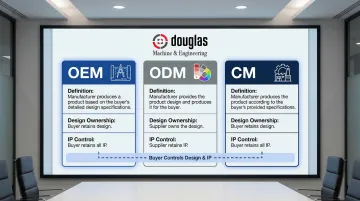
| Manufacturing Model | Definition | Design Ownership | IP Control |
|---|---|---|---|
| OEM (Original Equipment Manufacturer) | Produces goods based on the buyer's unique specifications | Buyer retains design authority | Buyer owns all IP and specifications |
| ODM (Original Design Manufacturer) | Uses its own existing designs that buyers rebrand | Supplier owns the design | Supplier controls the Bill of Materials |
| CM (Contract Manufacturer) | Manufactures strictly to customer drawings and specifications | Customer has full design ownership | Customer retains complete control |
When Each Model Is the Right Fit
OEM/CM arrangements are appropriate when you have proprietary designs and need a production partner to execute manufacturing to your exact specifications. This model gives you complete control over materials, tolerances, processes, and quality standards — critical when your competitive advantage depends on design innovation or when regulatory compliance requires absolute design authority.
ODM arrangements work when speed to market matters more than custom design. The manufacturer offers existing product designs you can sell under your own brand (white label). This cuts development time and cost, but you give up design control and the ability to differentiate your product.
That tradeoff is a dealbreaker in regulated industries. The AS9100D aerospace standard mandates strict configuration management, requiring control over product identity, traceability, and identified changes. Under an ODM model, you lack the necessary control over the Bill of Materials to satisfy these requirements. Aerospace, defense, and medical device manufacturers must maintain design authority — making OEM/CM the only viable approach.
What a Contract Manufacturing Agreement Covers
The contract manufacturing agreement is the legal document defining the relationship. It specifies scope of work, production volumes, quality standards, delivery timelines, intellectual property protections, confidentiality obligations, and liability allocation. Critical provisions include:
- Design ownership and IP rights
- Quality specifications and inspection criteria
- Delivery schedules and penalty clauses
- Confidentiality and non-disclosure terms
- Indemnification for patent infringement
- Change management procedures
- Termination conditions and transition planning
Skipping or shortcutting any of these provisions — particularly IP ownership and change management — is where manufacturing partnerships most commonly break down. Get the agreement right before production starts, not after a dispute surfaces.
Benefits of Contract Manufacturing
Cost Efficiency and Capital Avoidance
Outsourcing production eliminates the need to invest in expensive CNC machines, welding equipment, inspection systems, and manufacturing facilities. Instead of tying up capital in fixed assets, you convert large upfront investments into variable production costs that scale with demand. Implementing an AS9100 quality system alone can cost between $5,000 and $15,000 for small companies, scaling to $50,000 to $100,000+ for organizations with over 500 employees. Partnering with a pre-certified manufacturer allows you to bypass these implementation costs entirely.
In the defense sector, idle capacity is not an allowable cost on government contracts, which disincentivizes OEMs from acquiring capital equipment that cannot be consistently utilized. Contract manufacturing absorbs this risk while providing access to production capacity when needed.
Access to Specialized Expertise and Certifications
A qualified contract manufacturer brings industry-specific certifications and skilled tradespeople that would take years and significant cost to develop in-house. Key credentials to look for include:
- ISO 9001:2015: Demonstrates a mature quality management system focused on customer satisfaction and continuous improvement
- AS9100D: Required for aerospace and defense supply chains, with stringent requirements for configuration management, traceability, and design control
- AWS-certified welders: Ensures structural and precision welding meets national and international standards
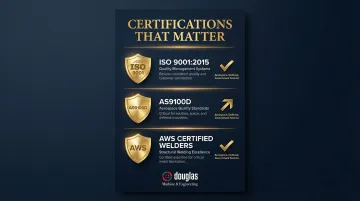
DM&E holds ISO 9001:2015 and AS9100D certifications along with AWS-certified welders, SAM registration, and CAGE Code 87BF4—credentials that enable participation in demanding aerospace, defense, and government programs without requiring clients to develop these capabilities internally.
Scalability and Flexibility
Contract manufacturing allows you to ramp production up during high-demand periods or scale back without carrying the overhead of idle equipment and workforce. This flexibility is particularly valuable for companies with seasonal demand or project-based production cycles. The U.S. defense industrial base must be ready to respond to surges in demand, but productive capacity and surge readiness currently form a weak spot. Utilizing contract manufacturers helps OEMs scale production without bearing the financial risk of excess capacity.
Focus on Core Competencies
Strategic management frameworks dictate that maximum enterprise value is created by concentrating internal resources on "core competencies" while strategically outsourcing other activities. When production is handled by a reliable partner, internal teams can concentrate on engineering innovation, sales, and customer relationships rather than managing shop-floor operations.
Nike and Apple illustrate this approach. Nike outsources 100% of its shoe production to focus on preproduction (R&D) and postproduction (marketing), while Apple historically outsourced 70% of its manufacturing costs to focus on proprietary software and design architecture.
The strategy has limits, though. Outsourcing functions that intersect with your true core competency can erode what makes you competitive—Boeing's 2005 spin-off and outsourcing of fuselage production to Spirit AeroSystems degraded its core strength of reliable execution, ultimately forcing Boeing to buy the supplier back.
Supply Chain Consolidation and Project Management
Working with a single contract manufacturing partner who coordinates suppliers, manages sub-processes, and delivers a complete product eliminates the administrative burden of managing multiple specialized subcontractors. This consolidation reduces the number of purchase orders, minimizes transportation costs between vendors, and keeps quality accountability in one place. Consolidating the supplier base yields significant operational efficiencies, improves efficiency across procurement and delivery, and allows companies to take advantage of large-scale and volume pricing discounts.
DM&E's one-stop-shop model coordinates in-house CNC machining, welding, and assembly with qualified partners for heat treatment, plating, and painting—delivering finished products under one purchase order while maintaining quality control throughout the entire process.
What to Look for in a Contract Manufacturing Partner
Certifications and Quality Systems
Certifications are non-negotiable for regulated industries. Verify these credentials before committing to a partner:
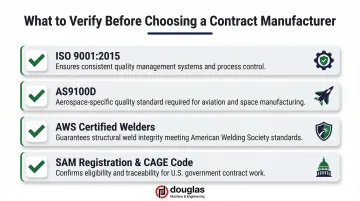
- ISO 9001:2015 — The globally recognized quality management standard, covering customer requirements, process control, and continuous improvement
- AS9100D — Builds on ISO 9001:2015 with additional aerospace and defense requirements; mandatory for aviation and defense supply chains
- AWS Certified Welders — Performance-based credentials from the American Welding Society, verifying personnel meet national and international standards for structural and precision welding
- SAM Registration and CAGE Code — Active SAM.gov registration is required to bid on U.S. government contracts; it generates a CAGE code, a 5-character identifier used by the Defense Logistics Agency for defense procurement
Capabilities, Capacity, and Communication
The right partner should have the in-house equipment and production capacity to meet current needs as well as future scale requirements. Responsiveness, transparency, and willingness to act as a collaborative partner — not just a transactional vendor — matter just as much as machine capacity.
DM&E's open-door policy and dedicated project management approach put this into practice. Direct access to manufacturing processes, quality systems, and compliance activities keeps every project visible. When issues arise, they get resolved promptly — not buried until the cost compounds.
Experience in Your Industry
Manufacturing tolerances, material requirements, and compliance standards vary significantly across industries. A manufacturer with demonstrated experience in aerospace, defense, pharmaceutical, or food-grade production understands these nuances and will flag potential issues before they become expensive rework.
31% of surveyed defense industrial base companies lack sufficient skilled workers for current production rates, and 30% lack sufficient cleared workers. A contract manufacturer with established expertise in your sector brings not only the equipment but also the qualified workforce and institutional knowledge necessary to execute successfully.
Frequently Asked Questions
How much do contract manufacturers charge?
Pricing depends on part complexity, materials, volume, certifications, and whether design or project management is included. Tighter tolerances increase costs through higher-grade materials, advanced equipment, and longer machining times. Consolidated multi-process contracts and longer production runs typically reduce per-unit cost.
What are contract manufacturing services?
Contract manufacturing services cover any production activity outsourced to a third party, including CNC machining, welding, assembly, finishing, packaging, and project management. Scope ranges from individual precision components to complete turnkey assemblies, depending on what the manufacturer offers and what the client needs.
What is OEM vs ODM vs CM?
OEM and CM both involve producing to the client's design, with the client retaining full design authority and intellectual property control. ODM involves the manufacturer supplying an existing design the client rebrands, with the supplier owning the IP. Most precision and regulated-industry work falls under OEM/CM arrangements because design control drives both compliance and competitive differentiation.
What industries use contract manufacturing?
Contract manufacturing spans aerospace, defense, automotive, pharmaceutical, food and beverage, agricultural equipment, robotics, construction, and industrial machinery. Any industry requiring specialized production processes, precision tolerances, or strict quality compliance benefits from partnering with a qualified contract manufacturer rather than building that capability in-house.
What certifications should a contract manufacturer have?
ISO 9001:2015 is the foundational quality management certification to look for across all industries. AS9100D is required for aerospace and defense work. AWS certification matters for welded structures. Government contractors should hold SAM registration and a CAGE code. Always match the manufacturer's certifications to your industry's compliance requirements—regulated sectors demand verifiable credentials, not just claims of capability.