Introduction
A turbine blade that deviates from specification by a few thousandths of an inch can trigger engine shutdown at 35,000 feet. A surgical implant outside its dimensional tolerances risks patient harm, product recalls, and regulatory action. In aerospace, defense, and medical devices, manufacturing accuracy directly determines whether a component performs safely in the field — there's no margin for interpretation.
Precision manufacturing produces components to extremely tight dimensional tolerances using computer-controlled machinery, with virtually no room for deviation from engineered specifications. This guide covers what precision manufacturing is, how it differs from standard approaches, the core CNC techniques involved, which industries depend on it most, and what to look for in a manufacturing partner.
TLDR:
- Precision manufacturing produces highly accurate, repeatable components within micron-level tolerances using CNC equipment and CAD/CAM software
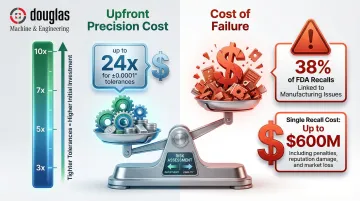
- Tolerances as tight as ±0.0001" can cost 24x more than ±0.005" — but prevent far costlier recalls and failures
- Key processes include CNC milling/turning, multi-axis machining, Swiss machining, EDM, and precision grinding
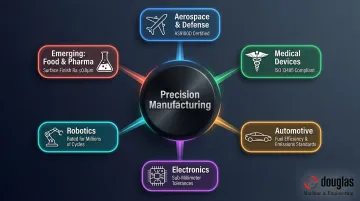
- Aerospace, defense, medical devices, automotive, and electronics rely most heavily on precision manufacturing
- ISO 9001:2015 and AS9100D certifications signal robust quality systems built to aerospace and defense contract requirements
What Is Precision Manufacturing?
Precision manufacturing is the production of highly accurate components from engineered designs, where the primary goal is repeatability—producing the same exact part, within a defined tolerance range, every time. Unlike manual machining or general fabrication, precision manufacturing delivers dimensional consistency across thousands of identical components, which is essential for interchangeable parts in complex assemblies.
Understanding Tolerances: The Language of Precision
Tolerance refers to the acceptable range of dimensional deviation on a finished part. The tighter the tolerance, the less allowable error. Precision manufacturing typically operates at tolerances measured in microns (µm) or thousandths of an inch.
Industry tolerances fall into three tiers:
- Standard tolerances: Governed by ISO 2768, typically ±0.005" (±0.13 mm)
- Precision machining: ±0.002" to ±0.0005" (±0.05 mm to ±0.013 mm)
- Ultra-precision: Single-digit microns or sub-micron capabilities, such as <2 µm positioning accuracy
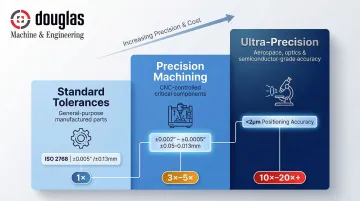
For perspective, moving from standard tolerances to extreme precision (±0.0001") can increase machining costs by up to 24x, driven by slower cutting speeds, specialized equipment, climate-controlled environments, and intensive CMM (coordinate measurement machine) inspection.
Accuracy vs. Precision: Two Critical Concepts
Accuracy and precision are related but not interchangeable in manufacturing:
- Accuracy: How close a measurement is to its target value
- Precision: How consistently that measurement is replicated across multiple parts
Both are necessary, but precision is what defines repeatability at scale. A process can be precise (consistently producing the same dimension) without being accurate (if that dimension is off-target). Precision manufacturing demands both.
The Role of CAD/CAM Software
Computer-aided design (CAD) and computer-aided manufacturing (CAM) software are the foundation of precision manufacturing. Engineers design parts digitally in CAD, which generates machine instructions (G-code) through CAM. Those instructions tell CNC machines exactly what to cut, drill, or shape, eliminating human error and enabling complex geometries impossible to produce manually.
Simulation tools extend this further. Advanced CAM software like Vericut simulates the machine tool, cutting tools, and workpiece in real time, identifying potential collisions, gouges, and interference before physical cutting begins. This reduces toolholder collisions to near zero and removes the need for manual dry runs.
Repeatability: The Defining Characteristic
Unlike manual processes where each part may vary based on operator skill and setup, CNC-driven precision manufacturing produces thousands of identical components with minimal deviation. This repeatability is what makes modern manufacturing possible: interchangeable parts fit as designed, assembly processes stay predictable, and product performance holds consistent across an entire production run.
Precision Manufacturing vs. Standard Manufacturing
The fundamental distinction between precision and standard manufacturing lies in tolerance requirements and their downstream implications.
Standard manufacturing involves wider tolerances and suits parts where minor variations are acceptable — structural steel beams, general hardware, or components where fit and function aren't interdependent. Standard tolerances (±0.005" or wider) allow faster production speeds, less specialized equipment, and sampling-based inspection rather than 100% verification.
Precision manufacturing demands tighter tolerances where deviations cause part failure or system malfunction. When a bearing seat is out of spec by 0.001", the bearing may seize or fail prematurely. When sealing surfaces don't meet flatness requirements, leaks occur. Dimensional accuracy directly determines whether the part functions as designed.
When Each Approach Is Appropriate
Use standard manufacturing when:
- Dimensional variations won't affect assembly or performance
- Parts are non-critical structural components
- Cost optimization is the primary driver
- High-volume production of simple geometries is required
Use precision manufacturing when:
- Fit, form, and function are interdependent
- Parts interface with other precision components
- Safety, regulatory compliance, or performance is critical
- Small errors have cascading consequences in the assembly
Cost Trade-Offs and Long-Term Value
Precision manufacturing is more resource-intensive — specialized machinery, strict quality control, and skilled operators all add cost. According to industry cost analysis, tightening tolerances from standard to precision levels can multiply part costs by factors of three to ten, depending on part complexity.
That cost, though, is far lower than the alternative. In medical devices, manufacturing issues account for nearly 38% of FDA recalls, with a single recall potentially costing up to $600 million. In aerospace, dimensional nonconformances can trigger FAA Airworthiness Directives requiring replacement of entire component batches.
Engineering best practice: Apply tight tolerances exclusively to functional features (sealing surfaces, bearing seats, mating interfaces) and use standard ISO 2768 tolerances for non-critical dimensions to optimize budgets without compromising performance.
Hybrid Approaches
Most real-world projects blend both approaches. Precision manufacturing covers critical components — engine internals, flight control actuators, surgical instruments — while standard methods handle non-critical ones like mounting brackets, enclosures, and covers. This strategic allocation keeps costs in check without sacrificing performance where it matters.
Key Methods and Techniques in Precision Manufacturing
CNC machining is the backbone of precision manufacturing: a broad category of computer-controlled subtractive processes guided by CAM software instructions. The most common techniques include:
CNC Milling and Turning
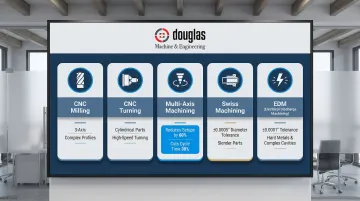
CNC milling uses rotary cutters to remove material from a stationary workpiece across multiple axes (typically 3-axis: X, Y, Z). Mills can create complex profiles, pockets, slots, and contoured surfaces with high precision.
CNC turning rotates the workpiece while a fixed cutting tool removes material, ideal for cylindrical parts like shafts, bushings, and fittings. These two techniques form the foundation of most precision work and are available in virtually every precision machine shop.
DM&E's CNC mills and lathes, for example, handle components up to 20,000 lbs with tolerances ranging from ±0.005" to ±0.0005"—covering both aerospace-grade precision and large structural fabrication requirements in a single shop.
Multi-Axis and Swiss Machining
When milling and turning aren't enough, multi-axis machining takes over. Multi-axis CNC machining (4-axis and 5-axis) enables simultaneous movement across three linear axes (X, Y, Z) and two rotary axes (A, B), allowing complete machining of complex components in a single setup — reducing setups from more than five to just two and cutting cycle times by 30%. The 5-axis machining market was valued at $4.8 billion in 2023, reflecting widespread adoption for aerospace, medical, and automotive applications.
Swiss machining feeds stock material through a guide bushing toward the cutting tool, allowing the tool to engage the material close to the point of support. This makes Swiss machining exceptionally effective for long, slender parts (typically 3:1 length-to-diameter ratio or more) and can reliably hold tolerances of 0.0005 inches on diameter. Swiss lathes are ideal for medical components, precision fasteners, and miniaturized aerospace parts.
Precision Grinding, EDM, and Laser Machining
Precision grinding uses abrasive wheels to achieve extremely tight tolerances and superior surface finishes that standard turning or milling cannot match. Typical cylindrical grinding tolerances range from less than ±1µm to ±10µm, with surface finishes (Ra) from 0.10µm to 80µm. Grinding is essential for bearing races, hydraulic cylinder bores, and precision shafts.
Electrical discharge machining (EDM) uses controlled electrical sparks to erode hard metals without physical contact, eliminating mechanical stress and burrs. Wire EDM routinely achieves tolerances of ±0.0001" and surface finishes as low as Ra 0.1–0.3 µm.
Sinker EDM extends those capabilities further, creating complex 3D cavities and sharp internal corners that milling cutters cannot reach — making it the go-to process for die and mold work.
CNC laser machining uses high-frequency laser beams for cutting or engraving both metals and non-metals. While highly precise and fast, the thermal nature of the process creates a heat-affected zone (HAZ) which can slightly reduce accuracy compared to mechanical processes. Laser cutting is preferred when speed and non-contact processing are priorities.
Industries That Rely on Precision Manufacturing
The global precision machining market was estimated at $123.54 billion in 2025 and is projected to reach $228.75 billion by 2033, growing at a CAGR of 8.1%. Several industries are driving that growth — each with distinct tolerance requirements, regulatory demands, and safety stakes.
Aerospace and Defense
Aerospace and defense set the highest bar for precision manufacturing. Components must perform reliably under extreme conditions — high temperatures, vibration, corrosive environments, and sustained mechanical stress — often with direct safety consequences.
Regulatory requirements are equally demanding. Aerospace structures must meet damage-tolerance evaluations under 14 CFR 25.571. Suppliers must hold AS9100D quality management certification and, for critical processes, Nadcap accreditation to ensure traceability and process control.
DM&E holds both ISO 9001:2015 and AS9100D certifications, supporting aerospace and defense programs that require first article inspection (FAI) reporting, documented quality systems, and full material traceability throughout production.
Medical Devices
Medical device manufacturing is governed by ISO 13485 and FDA 21 CFR Part 820 (Quality System Regulation). Implantable devices require exceptional surface finishes (Ra 0.1-0.4 µm) to prevent bacterial colonization and ensure biocompatibility. Manufacturers must validate their processes (IQ/OQ/PQ) to prove they can consistently produce components that meet these strict specifications.
Dimensional precision is critical: surgical instruments must fit together precisely, orthopedic implants must match anatomical specifications, and micro-machined components in diagnostic equipment require tolerances measured in microns.
Automotive, Electronics, and Robotics
Three additional sectors show how broadly precision manufacturing reaches:
- Automotive: Engine and drivetrain tolerances directly affect fuel efficiency and emissions. Fuel injectors, valve bodies, and transmission components all depend on precision machining to meet modern performance targets.
- Consumer electronics: Smartphones, laptops, and wearables pack components into tighter spaces every product cycle. Sub-millimeter tolerances and ultra-smooth surface finishes are standard requirements.
- Robotics: Actuators, joints, and gearing must maintain positional accuracy across millions of operating cycles. Industrial robots used for assembly, welding, or inspection are only as reliable as the components inside them.
Emerging Applications
Agriculture, food-grade packaging, and pharmaceuticals are converging on precision manufacturing as contamination control and regulatory compliance become non-negotiable. In food processing, for example, the European Hygienic Engineering and Design Group (EHEDG) requires product-contact surfaces to have a maximum roughness of Ra = 0.8 µm — a specification that demands the same level of machining discipline as many aerospace components. Pharmaceutical equipment faces similar surface and dimensional requirements tied to FDA validation protocols.
The Role of Quality Standards and Certifications
Third-party quality certifications are a reliable indicator that a manufacturer has documented, audited processes for producing consistent, precise components—covering not only equipment capabilities but the operational systems that govern how work gets done.
ISO 9001:2015
ISO 9001:2015 is the internationally recognized quality management system standard that ensures documented processes, traceability, and continuous improvement across all operations. It establishes requirements for:
- Process documentation and control
- Customer focus and satisfaction
- Risk-based thinking and preventive action
- Evidence-based decision making
- Management review and continual improvement
ISO 9001 certification demonstrates that a manufacturer has implemented systematic quality controls applicable across all industries.
AS9100D
AS9100D is the aerospace-sector-specific extension of ISO 9001, developed by the International Aerospace Quality Group (IAQG) and SAE International. It includes all ISO 9001:2015 requirements while adding stringent aviation, space, and defense industry requirements for:
- Configuration management and design control
- Risk management and safety assurance
- First article inspection (FAI) per AS9102
- Special process controls (heat treat, plating, welding, NDT)
- Counterfeit parts prevention
- Foreign object debris (FOD) prevention
DM&E holds both ISO 9001:2015 and AS9100D certifications, meaning aerospace and defense customers get full traceability, validated processes, and documented compliance built into every program — not treated as an afterthought.
AWS Certified Welding
AWS (American Welding Society) certification is a specialized credential that matters when precision manufacturing includes structural or specialty welding components. AWS Certified Welding Fabricator (CWF) accreditation proves a facility has the personnel, procedures, and equipment to conduct proper weldments according to AWS B5.17 standards. That accreditation ensures weld integrity meets defined specifications — not just by policy, but by verified practice.
DM&E employs AWS-certified welders and integrates specialty welding with precision machining, enabling complete fabrication of complex assemblies under unified quality control.
What to Look for in a Precision Manufacturing Partner
When evaluating precision manufacturing partners, consider these key criteria:
In-House Design and Engineering Capabilities
A partner with in-house design and engineering can take your concept, develop the manufacturing process, and produce a finished product without handoffs to external vendors. Working this way reduces errors, accelerates timelines, and keeps design intent intact throughout production.
DM&E operates as a one-stop shop with in-house design capabilities using PTC Creo, CATIA v5, and AutoCAD, combined with FeatureCAM CNC programming software. That means projects move from concept through installation without leaving their hands.
Full Range of Machining Processes Under One Roof
Splitting milling, turning, grinding, EDM, and welding across separate facilities fragments quality control and drives up transportation costs. A partner offering comprehensive processes in-house maintains consistent quality oversight and eliminates redundant shipping and handling.
Comprehensive Project Management
Look for a partner who project-manages your program from concept to delivery, coordinating all processes—whether performed in-house or through qualified suppliers—under unified oversight. This approach saves transportation costs, eliminates multiple purchase orders, and keeps quality control centralized.
Established Supplier Coordination
For specialized processes like heat treatment, plating, or NDT (non-destructive testing), verify that your partner maintains relationships with qualified, certified suppliers and integrates these services into the project workflow. Ask specifically how they vet and monitor those suppliers — a strong partner treats external processes as an extension of their own quality system.
Quality Certifications and Government Contracting Credentials
Verify that your partner holds credentials appropriate to your industry:
- ISO 9001 — baseline quality management system
- AS9100D — required for aerospace and defense work
- ISO 13485 — medical device manufacturing
- AWS certification — qualified welding operations
- CAGE code and SAM registration — necessary for U.S. government contracts
These aren't just paperwork. They indicate audited quality systems and demonstrated regulatory compliance.
Frequently Asked Questions
What is the difference between manufacturing and precision manufacturing?
Standard manufacturing works within broader tolerances suitable for general-purpose parts, while precision manufacturing operates at extremely tight tolerances—often measured in microns—where dimensional accuracy and repeatability are critical to part performance and system reliability.
What is precision manufacturing?
Precision manufacturing is the process of producing highly accurate, repeatable components from engineered designs using CNC machines and advanced CAD/CAM software, with minimal allowable deviation from specified dimensions, typically within tolerances of ±0.001" or tighter.
What is an example of precision manufacturing?
A CNC-machined turbine blade for a jet engine is a classic example. It must meet dimensional tolerances within ±0.0005" and precise surface finish specifications to withstand high temperatures, rotational forces exceeding 10,000 RPM, and mechanical stress across thousands of flight hours.
What is the meaning of precision quality?
Precision quality refers to a part's consistent conformance to its exact dimensional and functional specifications across an entire production run—not just a single accurate part, but every part holding the same tight tolerances with minimal variation.
What industries rely most on precision manufacturing?
Aerospace, defense, medical devices, automotive, and electronics are the primary industries. Robotics, pharmaceuticals, food-grade packaging, and agricultural equipment are fast-growing adopters, driven by requirements for dimensional consistency, contamination control, and regulatory compliance.
What certifications should a precision manufacturer have?
ISO 9001:2015 certifies a quality management system applicable across industries. AS9100D adds aerospace- and defense-specific requirements for safety, traceability, and process control. Credentials like AWS-certified welding and ISO 13485 for medical devices indicate specialized process quality assurance.