Introduction
A single defective component reaching an aerospace assembly line can trigger cascading failures: costly recalls, project delays, regulatory fines, and safety hazards. In 2019, the FAA levied a $3.9 million penalty against Boeing for installing hydrogen-embrittled slat tracks on 133 aircraft—a quality escape that originated with inadequate supplier oversight. More recently, the FAA grounded 171 Boeing 737-9 MAX jets following the in-flight blowout of a mid-cabin door plug, exposing systemic inspection failures.
For quality managers, engineers, procurement leads, and operations teams in precision manufacturing, these failures share a common root: inspection programs that couldn't catch defects before they escaped.
This guide gives you a practical, end-to-end framework for quality inspection—covering types, processes, and best practices you can apply to catch defects early, reduce cost of poor quality, and stay compliant in regulated industries.
TLDR:
- Quality inspection measures product characteristics against specifications to verify conformance
- Production-stage inspection covers four phases: Incoming (IQC), In-Process (IPQC), Final (FQC), and Outgoing (OQC)
- Specialized types include First Article Inspection (FAI), source inspection, and returned material inspection
- Every effective inspection follows five steps: define criteria, sample, inspect, document, then correct
- Strong programs combine trained inspectors, standardized checklists, and real-time data to drive continuous improvement
What Is Quality Inspection?
The American Society for Quality (ASQ) defines quality inspection as a verification activity where one or more product characteristics are examined and compared against specified requirements to assess conformity. In practice, it's the systematic process of measuring, testing, and documenting whether a product meets its design specifications before it moves forward in the supply chain.
Inspection vs. Quality Control
Quality inspection differs from Quality Control (QC) in scope and purpose. Inspection is the check—a point-in-time verification that a product meets specifications. Quality Control is the broader feedback system that uses inspection data to drive correction and improvement. Quality Assurance (QA) encompasses all planned activities that provide confidence quality requirements will be fulfilled, while QC refers to operational techniques used to fulfill those requirements.
In regulated manufacturing environments, this distinction matters. Inspection generates the objective evidence—measurements, test results, documentation—that proves conformance. QC takes that evidence and feeds it into corrective action systems, process improvements, and supplier feedback loops.
What Gets Evaluated During Quality Inspection
Understanding what inspection covers clarifies why it sits at the foundation of any quality system. Quality inspections in precision manufacturing cover five core areas:
Physical Dimensions and Geometric Tolerances:
- Length, diameter, wall thickness, and surface finish
- Geometric Dimensioning and Tolerancing (GD&T) requirements
- Ensures proper fit, form, and alignment in complex assemblies
Material Conformity:
- Material certifications and chemical composition verification
- Confirms raw materials meet aerospace/defense specifications
- Prevents structural failures from material substitution
Performance and Functionality:
- Load testing, pressure testing, electrical testing
- Validates that products perform as designed under operating conditions
Safety and Regulatory Compliance:
- Verification against industry standards (ISO, AS9100, MIL-STD)
- Documentation of critical characteristics and key product characteristics
- Traceability to engineering drawings and customer requirements
Compliance Documentation:
- Material certificates, test reports, inspection records
- Provides objective evidence for regulatory audits and customer acceptance
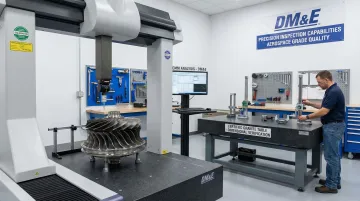
For AS9100D-certified manufacturers like DM&E, this documentation isn't optional—it's the objective evidence required to satisfy customer flow-down requirements and pass regulatory audits. DM&E uses coordinate measurement machines (CMM), certified granite tables, and First Article Inspection (FAI) reporting to verify conformance at each stage of production.
The 4 Types of Quality Inspection
Quality inspection types are categorized two ways: by production stage (most common in manufacturing quality control) and by purpose (used in supply chain and regulated industries). Both frameworks overlap and complement each other. Most inspection types use ISO 2859-1 Acceptance Quality Limit (AQL) sampling methodology to balance risk and efficiency.
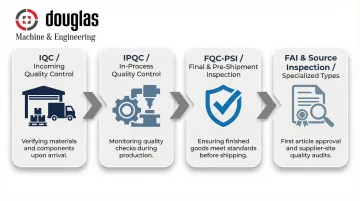
These stages — IQC, IPQC, Final/PSI, plus specialized types used in precision manufacturing — each address a distinct point in the production lifecycle. The first three apply broadly across industries; the specialized types below operate within those stages for aerospace, defense, and high-tolerance work.
Incoming Quality Control (IQC)
IQC occurs before raw materials or components enter the production line. Inspectors verify that incoming materials conform to purchase order specifications, check for shipping damage, and validate supplier documentation including material certificates and test reports.
When IQC is critical:
- New suppliers without proven quality history
- Large contracts where defects would create significant financial exposure
- High-risk materials (aerospace alloys, safety-critical components)
- Materials with long lead times where rework would delay production
For proven suppliers with consistent quality records, ISO 2859-3 skip-lot sampling reduces inspection costs by randomly accepting lots without full inspection. Acceptance is based on specified probabilities rather than 100% review.
DM&E requires suppliers to inspect products prior to shipment and maintains the right to conduct incoming inspections on all received materials. Non-conforming material cannot be shipped without prior written consent, and DM&E retains 30 days from receipt to notify suppliers of defective goods.
In-Process Quality Control (IPQC)
In-process inspections occur while production is underway, typically when 10–15% of units are complete. The goal is to catch deviations early before they become systemic failures affecting entire production runs.
What IPQC assesses:
- Workflow adherence to documented procedures
- Dimensional accuracy at critical manufacturing stages
- Tooling calibration and machine setup validation
- Worker skill validation and process capability
The cost benefit of in-process inspection is substantial. The "1-10-100 rule" demonstrates that defects costing $1 to fix during production cost $10 at final inspection and $100 (or more) post-delivery. Catching defects mid-production prevents compounding waste and rework costs.
Final and Pre-Shipment Inspection (FQC/PSI)
Final inspection is the last checkpoint before products move to stock or shipment. The entire finished product is measured against engineering specifications, customer requirements, and applicable standards.
Final inspection requirements:
- All manufacturing operations are complete
- All non-conformances from earlier stages are resolved
- Dimensional verification confirms specifications are met
- Functional testing validates performance requirements
- Packaging and labeling meet customer specifications
- Traceability documentation is complete and accurate
A Pre-Shipment Inspection (PSI) variant is used in supply chain contexts where goods are inspected when at least 80% are packed. PSI focuses on packaging integrity, labeling accuracy, and final compliance verification before shipment authorization.
Specialized Inspection Types in Precision Manufacturing
Three inspection types operate within the standard stages above, adding rigor required in precision, aerospace, and defense manufacturing:
First Article Inspection (FAI) validates a new part or process against design specifications before full production begins. AS9102 defines documentation through three forms: Part Number Accountability (Form 1), Product Accountability (Form 2), and Characteristic Accountability (Form 3).
FAI is mandatory under AS9100D and must be repeated when any of the following change:
- Manufacturing source or process
- Inspection method
- Production has lapsed two or more years
Source/On-Site Supplier Inspection is conducted at the supplier's facility before shipment — particularly for critical components or new suppliers. It verifies that quality systems are functioning and that products meet specifications before entering the customer's supply chain.
Returned Material Inspection applies to parts sent back for rework. Re-inspection before these parts re-enter inventory prevents defective reworked components from contaminating production and establishes traceability for corrective action effectiveness.
DM&E performs FAI reporting, CMM analysis through Exact Metrology, and dimensional verification on certified granite tables — capabilities that directly support AS9100D compliance for aerospace and defense programs.
The Quality Inspection Process: Step by Step
Step 1: Define Inspection Criteria
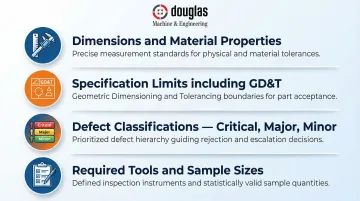
Every inspection starts with documented, criteria-based inspection plans tied to engineering drawings, customer requirements, and regulatory standards. Effective criteria specify:
- Dimensions, material properties, and performance characteristics to be measured
- Upper and lower specification limits, including GD&T requirements
- Defect classifications: critical, major, and minor nonconformances
- Required tools, inspection conditions, and sample sizes for each measurement
Vague or outdated criteria are among the leading causes of failed inspections. Criteria must be part-specific and revised whenever engineering changes occur — which makes Step 2, selecting the right sampling method, equally important.
Step 2: Select a Sampling Method
ISO 2859-1 Acceptance Quality Limit (AQL)